 0410 686 585

You don’t need experience to begin Kung Fu or Kickboxing. Martial arts in Penrith can give beginners a structured way to build skills, fitness and confidence at their own pace.
It’s natural to wonder whether your child will feel comfortable, whether a trial lesson is free and which class suits their age. Look for a welcoming starting point with clear expectations and step-by-step progress.
This guide explains what beginners can expect from Kung Fu and Kickboxing, what to know about trial lessons and how age can guide your class choice. You’ll get a clearer sense of where children, teens and adults can start, and which training may suit their goals. No experience is needed, just a willingness to learn, move and keep building.
Key Takeaways
- See how beginners can approach kung fu or kickboxing and build skills step by step.
- Learn what a kids’ trial can help you assess before choosing a class.
- Discover the starting age for children’s martial arts and what can shape a suitable class choice.
- Explore how instructor support and training pace can help children develop confidence, focus and discipline.
Is the kids martial arts trial really free?
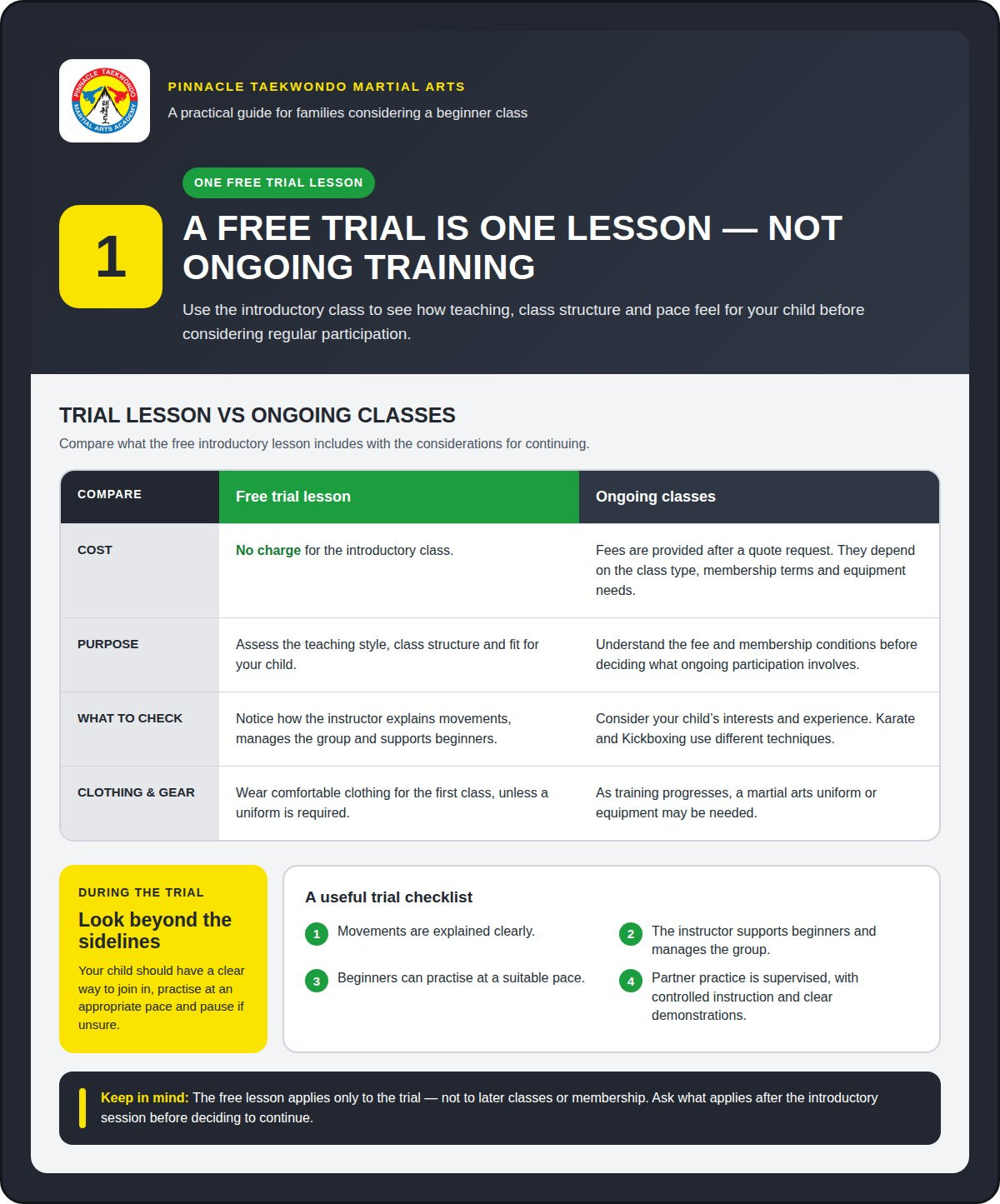
A trial is free only when the introductory class has no charge. Pinnacle Taekwondo Martial Arts offers one free trial lesson. Use it to assess the teaching style, class structure and fit for your child.
Free trial classes
During a trial, notice how the instructor explains movements, manages the group and supports beginners. Your child should have a clear way to join in, practise at an appropriate pace and pause if unsure. These details matter more than simply watching from the edge.
When comparing children’s martial arts classes in Penrith, consider your child’s interests and experience. Karate and Kickboxing use different techniques, so a trial can help your family see which structured class feels engaging. Adults can also use an introductory lesson to understand the teaching approach. The free lesson applies only to the trial, not to later classes or membership.
Fees, memberships and training equipment
Class fees depend on the training arrangement and are provided after a quote request; relevant factors include the class type, membership terms and equipment needs. Read the fee and membership conditions together, so you understand what ongoing participation involves. Ask what applies after any introductory session before deciding to continue.
Wear comfortable clothing for your first class unless a uniform is required. As training progresses, you may need a martial arts uniform or equipment. A suitable training space should be clear and organised. Class times also matter for families balancing school, work and other commitments.
Beginners should look for controlled instruction, clear demonstrations and close supervision during partner practice. Martial arts carries injury risks, including strains and contact-related knocks; suitable pacing and attention to technique help manage them. Children and adults should be able to speak up if a movement feels uncomfortable. A welcoming class supports effort without pressuring students to move faster than they can manage.
Instructor support and training at an individual pace
Good instruction breaks unfamiliar movements into manageable steps. Instructors demonstrate techniques, observe students as they practise and adjust their guidance to each student’s learning pace.
Martial arts training around Penrith includes styles such as Karate, Kung Fu, Taekwondo, Self-Defence and Kickboxing. For families in Penrith and nearby Caddens, consider your goals, preferred training style and class atmosphere. Beginners can build movement skills before taking on more complex techniques.
Self-Defence and anti-bullying training can help children practise clear, assertive responses. For example, a class may cover awareness, confident communication and ways to seek help from a trusted adult at school. These skills support a child’s readiness, but they don’t replace adult support when bullying occurs. Notice how instructors explain boundaries and supervise partner activities.
A family-friendly environment makes it easier for children and adults to learn alongside students with different experience levels. Look for instructors who explain expectations clearly, encourage respectful behaviour and let students progress without pressure. A supportive atmosphere should still include structure, focused practice and consistent guidance.
Location matters for regular attendance. Penrith and Caddens are nearby areas to consider when fitting classes around school, work and family routines. Travel time can affect consistency, while suitable class times help make training part of the week.
A fixed 20-week MMA training program is a different format from ongoing classes, so its schedule and progression should be clear. MMA combines elements such as boxing and grappling, while the available class styles here include karate, kung fu, taekwondo and self-defence. Choose instruction that matches the student’s goals rather than assuming every program covers the same skills.
For structured self-defence classes, consider the student’s experience, learning pace and preferred training style before settling into regular sessions.
WHAT AGE CAN CHILDREN START MARTIAL ARTS?
Children can start martial arts at age 3; the curriculum starts at age 3. Age alone doesn’t determine whether a class fits. A child’s ability to listen, follow a simple instruction and join a group also matters. For example, a young beginner might practise basic movements before learning a longer sequence. A suitable class gives children room to learn at a pace that matches their readiness.
Training gives children opportunities to practise confidence, discipline and everyday skills. Taking turns, listening to an instructor’s demonstration and trying again after a mistake are useful examples. These habits can carry into school routines and social activities. Progress comes through consistent effort, not pressure to master every movement immediately. Supportive instructors set clear expectations and recognise effort as children develop new skills.
Focus develops through structured practice. A child might watch a demonstration, copy a stance and repeat a movement while paying attention to balance. These activities also give children opportunities to develop coordination, physical control and strength over time. Short instructions and clear routines help young students know what to do next. Each class should balance active movement with listening and respectful interaction.
Discipline means following class expectations, respecting others and controlling movements during practice. Students can practise waiting their turn and stopping when instructed. These routines support confidence and social skills, but martial arts alone cannot solve challenges at school or home. The instructor’s guidance and the child’s willingness to participate shape the experience.
A trial lesson gives families a practical look at the teaching approach. Notice whether your child can follow instructions, participate comfortably and engage with the group. Consider how the class accommodates different abilities and introduces movements progressively. The right starting point is a class where children can practise safely, build coordination and feel encouraged to keep learning.
Children’s martial arts programs by age
The curriculum starts at age 3. For a young child, readiness also means being able to follow a simple instruction, take turns and join a group activity. A useful starting class introduces movement and technique in manageable steps, such as practising balance before linking movements together. The aim is steady participation, not expecting every student to learn at the same pace.
As children grow, their coordination, attention and confidence can shape the training that suits them. A child who enjoys repeating movements may respond well to structured technique practice, while another may prefer more varied activities. Age groupings can help match students with peers, but a child’s experience and comfort in class matter too.
When comparing martial arts for children, focus on what each class teaches and how skills build over time. Karate, Kung Fu and Taekwondo have distinct techniques, so a child may connect more strongly with one style. Respectful routines, clear instructions and achievable challenges can help students build confidence while learning to work with others.
The Working With Children Check, often shortened to WWCC, is a screening measure associated with child-related work. It is one part of a child-focused safeguarding approach, alongside active supervision, clear boundaries and respectful interactions. A friendly environment should make expectations easy to understand for students and families.
Use a trial lesson to observe how children are grouped, how instructions are explained and whether beginners can take part comfortably. Notice whether the class balances learning with movement and whether students show respect for instructors and classmates. These practical details can help you judge whether the program suits your child’s age, experience and learning style.
Explore children’s martial arts classes to find a structured starting point for your child.
Pinnacle Taekwondo Martial Arts
Pinnacle Taekwondo Martial Arts gives families a local starting point for children’s training in Penrith and Caddens. Its kids’ classes include Martial Arts, Kung Fu, Self-Defence and Taekwondo, offering different paths for children with different interests. Choose a structured class to help your child build skills and confidence.
Consider what your child wants to learn, whether that’s focused technique, practical Self-Defence or a broad introduction to martial arts. A clear fit between your child’s interests and the class can make regular training feel purposeful. Contact Pinnacle Taekwondo Martial Arts to discuss a suitable starting point for your family.
Choose a starting point and build from there
Match training to the student’s goals and interests. A child might want to learn new movements, practise focus or feel more confident in a group. Adults can also start with a personal goal, such as developing fitness or learning practical skills. Progress begins with showing up, listening and practising consistently.
For families exploring martial arts in Penrith, Pinnacle Taekwondo Martial Arts offers Kids Martial Arts, Kids Kung Fu and Kids Self-Defence. Each provides a structured way for children to learn and develop through training. Consider which option best fits your child’s interests and goals. A strong fit can make practice feel purposeful and keep motivation growing.
Take the next step with a conversation about your family’s goals and the kind of training you’re seeking. Contact Pinnacle Taekwondo Martial Arts to explore a suitable starting point. Every student begins somewhere. Bring curiosity, commit to learning and keep building confidence one session at a time.
Frequently Asked Questions
Can beginners start kung fu or kickboxing?
Yes. Beginners can start Kung Fu or Kickboxing without previous martial arts experience. Instructors introduce foundational movements before students combine them into more complex sequences. For example, a new Kickboxing student can practise stance and controlled punches first. Someone starting Kung Fu can focus on basic movements and class routines before progressing to more challenging techniques.
How do I try a class?
Book one free trial lesson to experience a class before deciding whether to continue. Use the session to see how instructors demonstrate movements, guide students and organise training. Notice which activities engage you, such as learning a technique or practising a sequence. A trial gives you a practical introduction and helps you decide whether the approach suits your goals.
Where are you located?
Classes serve Penrith and nearby Caddens, as well as Marrickville, Earlwood, Chester Hill, Bankstown and Sydney’s Inner West. For families considering martial arts in Penrith, Caddens is a nearby area to factor into travel plans. The service area also includes South West Sydney, giving students across these suburbs a local training option.
What ages do you teach in Penrith?
Children can start from age 3. The children’s programs are Mini Rangers for ages 3-6, Martial Rangers for ages 7-12, and Teen’s Martial Arts for ages 13-18. Adults can also train, with no specific age limit stated for the adult program. Match the student to the appropriate age group, then consider their experience and goals when choosing a class.
Which martial art should I choose?
Choose a style that fits your goals and the skills you want to develop. Taekwondo may appeal if you’re interested in structured kicking techniques, while Boxing or Kickboxing may suit you if you’re drawn to striking practice. Kung Fu, Karate and Hapkido offer other approaches to movement and technique. If personal safety is a priority, consider training that includes practical Self-Defence.
Which martial arts styles are taught in Penrith, such as karate, taekwondo, jiu-jitsu, boxing and Muay Thai?
Martial arts in Penrith include Taekwondo, Korean Karate, Japanese Karate, Kung Fu, Hapkido, Boxing and Kickboxing. Classes also cover Martial Arts Fitness, practical Self-Defence and Olympic-style Sports Taekwondo. Jiu-jitsu and Muay Thai aren’t among the listed styles. Compare the techniques and training focus of the available options with your interests to find a suitable starting point.