 0410 686 585

A child doesn’t need to be fearless or especially athletic to start karate. Kids’ karate classes in Chester Hill can suit children who are ready to listen to an instructor, join structured activities and practise alongside others. Readiness matters more than a particular age.
It’s understandable to want more than exercise from a class. With instruction and regular practice, karate can help children build confidence, focus and self-discipline through achievable challenges. It can also introduce practical ways to respond to bullying, such as speaking clearly, setting boundaries and seeking help from a trusted adult. Training supports these skills, but doesn’t guarantee a particular outcome.
This guide explains how to judge whether your child is ready to begin, what to expect from children’s karate training and how classes can support their development. You’ll also learn what to look for in a welcoming, structured environment where young beginners can practise at their own pace and develop through effort.
Key Takeaways
- Look for readiness to listen, join structured activities and practise with others rather than focusing on a specific starting age.
- Notice how regular training can help children develop focus, discipline and confidence through steady practice.
- Understand that self-defence includes setting boundaries, speaking clearly and seeking help, not just physical techniques.
- Explore the children’s martial arts options in Chester Hill to find a training path that suits your child’s interests and goals.
What is kids Karate in Chester Hill?
Children’s karate in Chester Hill combines physical movement with structured practice. Children learn stances, simple techniques and respectful training habits, then build control by repeating movements. There’s no single starting age that suits every child. Readiness depends on whether a child can follow an instructor’s directions and take part in a group.
Karate is one martial arts style, but not the only option. Taekwondo emphasises kicking techniques, while Kung Fu includes a range of movement traditions. Kickboxing and Hapkido offer different approaches to physical training. A children’s program should suit young learners, helping beginners practise foundational movements before moving on to more complex drills.
Compared with nearby Bankstown and Earlwood, Chester Hill gives families a local option for children’s martial arts training. The right fit depends on practical details such as travel, class times and whether the teaching environment suits your child.
A children’s martial arts venue in Chester Hill is at 12 Banool Street, Chester Hill, NSW 2162. Families travelling from Bankstown or Earlwood can consider this local option; other class locations and timetables vary.
Beginner classes provide an entry point for children without previous experience. Pinnacle Taekwondo Martial Arts offers one free lesson, giving your child a chance to experience a class before deciding whether to continue.
For a first session, keep preparation simple. Comfortable clothing allows easy movement, and a water bottle helps your child stay refreshed. A uniform is useful for training once required, while protective martial arts equipment is intended for specific drills, not general wear.
Timetables shape the weekly routine. Review children’s sessions for suitable days and times, then consider travel from Chester Hill, Bankstown or Earlwood. Class structure can vary by age and experience, so beginners benefit from clear instructions and manageable practice.
Controlled movement is an important part of supervised practice. Partners follow instructions and keep contact appropriate to the drill. Sparring should be guided by the instructor, not treated as a test children must pass.
Confidence, discipline and focus
Confidence grows through practice, not praise alone. A child learns a movement, tries it again and sees progress through effort. In martial arts training, a clear instruction such as “step, guard, bow” gives beginners a practical sequence to follow. Completing it can help build self-belief, especially for children who feel unsure in new group activities.
Discipline develops through small habits. Arriving ready, listening while an instructor demonstrates and waiting for a turn give children opportunities to practise respect. Repeating a basic stance also teaches patience: balance and control improve through attention, not rushing. These habits can support learning beyond training, while each child develops at their own pace.
Focus has a physical and mental side. A child might watch a demonstration, remember the order of two movements and perform them with control. A training mat defines a space to practise foot placement, while a visual target can help direct a technique during supervised drills. These tools give attention a clear purpose.
Fitness activities can add energy and variety. A short movement drill, followed by a pause to reset and listen, asks children to shift from action to concentration. Kung Fu and karate use distinct movements, but both can involve repetition, coordination and attention to instruction. Adults may train for different goals; children benefit from lessons shaped around their stage of development.
Progress isn’t a race. Learning a new combination or showing better control can mark a personal pinnacle, even before a child masters the next skill. In west Sydney, families considering children’s classes can look for teaching that recognises effort and gives useful, specific feedback. Explore structured martial arts training as one way to give your child regular practice with clear goals.
Self-defence and bullying prevention
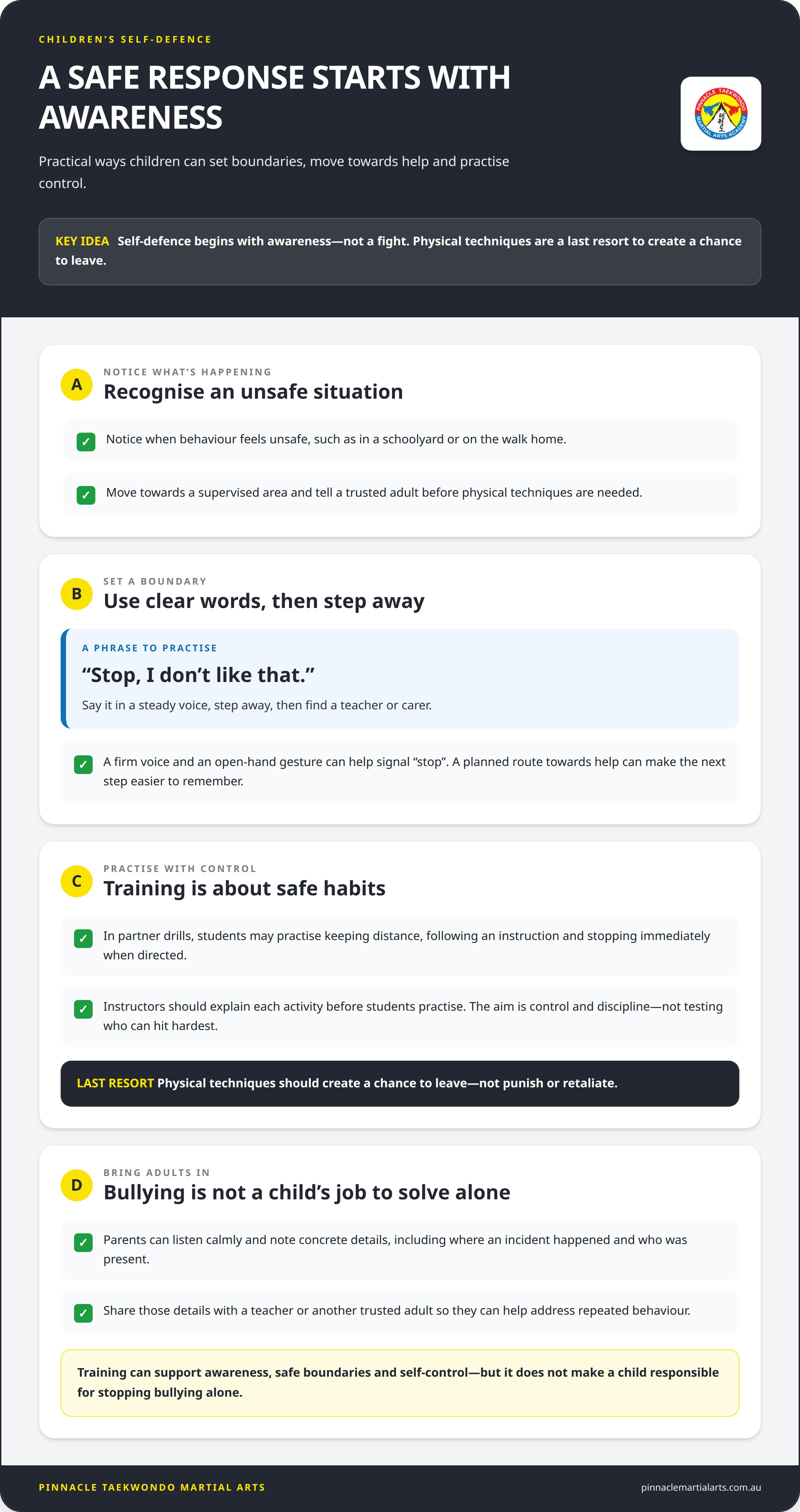
Self-defence for children starts with awareness, not a fight. In a schoolyard or on the walk home, a child can notice when behaviour feels unsafe, move towards a supervised area and tell a trusted adult. These choices offer a practical response before physical techniques are needed.
Clear words matter. A child can practise saying, “Stop, I don’t like that,” in a steady voice, then step away and find a teacher or carer. This doesn’t make a child responsible for stopping bullying alone. Adults need to know what happened so they can help address repeated behaviour.
Martial arts classes can teach controlled movement, balance and awareness of personal space. For example, a partner drill might ask students to keep their distance, follow an instruction and stop immediately when directed. The purpose is control and discipline, not testing who can hit hardest. Instructors should explain each activity before students practise.
Useful self-defence tools include a firm voice to set a boundary, an open-hand gesture to signal “stop”, and a planned route towards help. Rehearsing those steps can make a response easier to remember under pressure. Physical techniques should be taught as a last resort to create a chance to leave, not as a way to punish or retaliate.
Parents can support bullying prevention by listening calmly and recording concrete details, such as where an incident happened and who was present. A child can then share those details with a teacher or another trusted adult. Families in Chester Hill and nearby Bankstown can explore martial arts instruction that teaches awareness alongside technique. Children can practise self-control, safe boundaries and the confidence to ask for help.
Kids karate classes in Chester Hill
Kids’ karate classes in Chester Hill, NSW, give children a structured way to develop movement, technique and self-control. Available children’s options include karate and Taekwondo, with Kung Fu, Kickboxing and Hapkido providing other martial arts pathways. The right class depends on a child’s interests, confidence and readiness to learn with a group.
For families in south-west Sydney, an academy’s teaching approach matters as much as its style. Instructors can introduce a basic stance, demonstrate a sequence, then guide children through practice. This step-by-step structure helps beginners learn skills before combining them into more challenging movements. Age-appropriate instruction keeps the focus on control and steady progress.
A black belt may take 3 to 4 years, depending on commitment. Treat that as a possible progression, not a deadline: attendance, effort and learning each required skill shape a student’s journey. A practical first step is to understand how beginners are taught, how progress is recognised and how the class supports children with different experience levels.
Simple equipment supports specific parts of training. A uniform allows freedom of movement, a mat defines the practice area, and a focus pad gives instructors a target for controlled techniques. These tools serve different purposes, and children should use them as directed during class. They help make practice clear and purposeful.
Choose a class around your child’s goals. Karate may appeal to a child keen to practise hand techniques and stances, while Taekwondo offers a different martial arts format. Consider the class timetable alongside school and family routines, then look for clear instruction and a positive learning environment. Explore children’s karate and martial arts classes as a next step for building practical skills through structured training.
Pinnacle Taekwondo Martial Arts
Pinnacle Taekwondo Martial Arts gives families a local option for structured martial arts training for children. Its kids’ programs include Kids Martial Arts, Kids Kung Fu, Kids Self Defence and Kids Taekwondo. Parents can consider different training approaches while keeping their child’s goals, interests and readiness in view.
Turn to Pinnacle Taekwondo Martial Arts for guidance on choosing a suitable direction, whether your child is new to training or keen to develop existing skills. Each martial arts style offers a different focus, so the right starting point depends on what your child hopes to learn. Contact the school to discuss children’s training options.
Choose a next step that suits your child
A child’s first training goal doesn’t need to be dramatic. It might be joining in confidently, remembering a sequence or staying focused through a full activity. Talk about what your child wants to try, then use that goal to guide your next conversation about training.
If you’re considering kids’ karate classes in Chester Hill, Pinnacle Taekwondo Martial Arts can help you explore a suitable direction. Its children’s options include Kids Martial Arts, Kids Kung Fu and Kids Self Defence. Start with an option that matches your child’s interests and gives them room to learn steadily.
Progress comes through showing up, listening and practising with purpose. Focus on effort and personal development rather than comparing children’s results. A supportive first step can help your child approach training with curiosity and build confidence through experience.
Contact Pinnacle Taekwondo Martial Arts to discuss children’s training. Encourage your child to take that first step with confidence.
Frequently Asked Questions
At what age can children start Martial Arts lessons?
Children can start from age 3 in the Mini Rangers program, designed for ages 3-6. Martial Rangers is for children aged 7-12, while Teen’s Martial Arts is for ages 13-18. These age-based pathways give families a clear starting point. For a younger child, a parent can consider whether a short, structured group activity suits their interests and stage of development.
Do all ages and fitness levels train together?
No, the children’s programs are organised into age-based pathways rather than one class for every age. Mini Rangers covers ages 3-6, Martial Rangers ages 7-12, and Teen’s Martial Arts ages 13-18. Training is designed for different fitness levels, so age and current ability both inform a suitable starting point. Adults also have a separate martial arts program.
How long will it take for my child to reach black belt level?
A child may reach black belt in around 3 to 4 years, depending on commitment. Treat that timeframe as a guide, not a fixed deadline. Progress reflects how consistently a student trains and develops the skills required at each stage. Children can focus on learning each technique with control, rather than rushing towards a belt as the only measure of progress.
What are the benefits of martial arts training?
Martial arts training can develop coordination, fitness, social skills and character alongside practical movement skills. Practising footwork challenges balance, while paired activities give children a chance to cooperate and follow instructions. Structured training also offers purposeful physical activity. The skills children develop depend on their training and ongoing effort, not a guaranteed outcome.
What are the charges?
Charges depend on the selected program and training arrangement, and are provided after a quote request. Start by identifying whether you’re considering a children’s group program, private one-to-one coaching or another format. That helps establish which costs apply to your needs. No single fee should be assumed across different programs, as the training choice affects the quote.
What variety of programs do you offer at your clubs?
Children can choose Kids Martial Arts, Kids Karate, Kids Taekwondo, Kids Kung Fu or Kids Self Defence. Other classes include Karate, Taekwondo, Kung Fu, Kickboxing and Hapkido, with fitness sessions, private coaching and after-school care also available. Programs serve Sydney communities including Chester Hill, Bankstown, Marrickville, Earlwood, Penrith and Caddens, across the Inner West and south-west areas.