 0410 686 585

Your first karate class isn’t a test. It’s a chance to step onto the mat, learn the basics and build confidence at your own pace. Karate classes in Earlwood offer children, teens and adults a structured way to practise movement, focus and self-discipline, whether they’re complete beginners or returning to training.
It’s natural to wonder what happens when you arrive, especially if your child feels shy or you haven’t trained before. Expect guidance through the session, time to practise foundational movements and encouragement to learn one step at a time. This guide explains what to expect at a first class, how age-specific programs support kids, teens and adults, and what to consider when choosing a class. You’ll have a clearer picture of how training works and how to take the next step with confidence.
Key Takeaways
- Know what a beginner can expect in their first class, from learning basic movements to practising at a comfortable pace.
- Consider how a program suited to a child’s age and stage can make training more engaging and supportive.
- See how regular practice can help develop fitness, focus, confidence and discipline alongside martial arts skills.
- Explore what to look for in kids’ karate classes in Earlwood, including a welcoming approach that encourages steady progress.
Children’s martial arts and self-defence
For children, martial arts training combines movement, attention and respectful practice. A class might introduce a simple stance, a straight punch into the air, then a controlled step back. These small tasks give beginners clear actions to practise without expecting them to master complex techniques straight away. Repetition helps children learn how posture, balance and controlled movement work together. Martial arts etiquette also means listening to instructions, taking turns and showing respect to training partners.
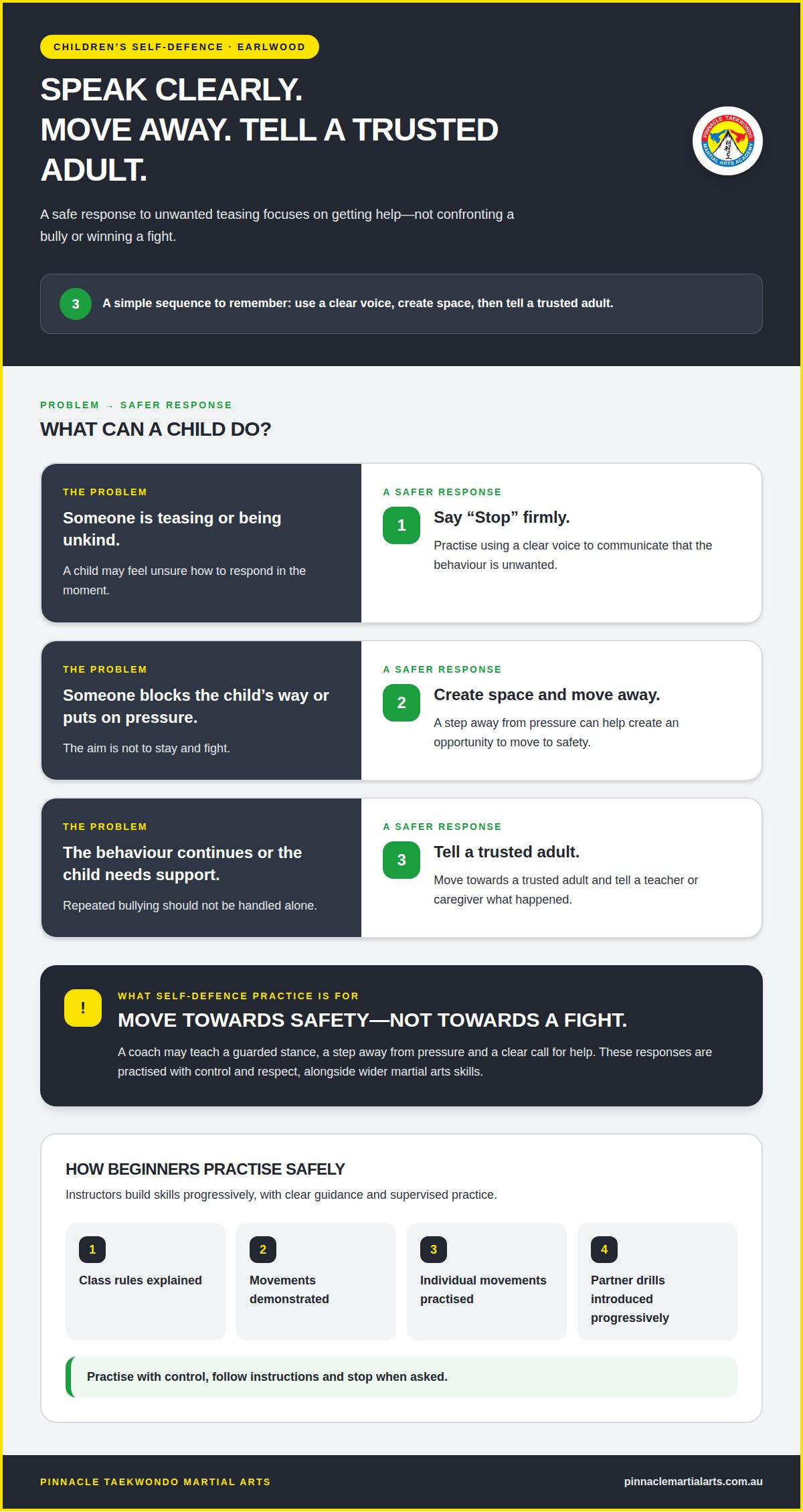
Instructors support beginner safety by explaining class rules, demonstrating movements and supervising practice. They can build skills progressively, starting with individual movements before introducing partner drills. Children should practise with control, follow instructions and stop when asked. This structure helps reduce avoidable contact and gives beginners time to learn to move safely.
Self-defence and anti-bullying training should cover more than physical techniques. Children can practise using a clear voice, creating space and moving towards a trusted adult. For example, a child facing unwanted teasing can say “stop” firmly, leave the situation and tell a teacher or caregiver. These steps support assertive communication without suggesting that a child must confront a bully or handle repeated bullying alone. Karate-based self-defence can add simple movement and awareness practice, taught with control and respect.
Martial arts self-defence is most useful when children understand the purpose of each action. A coach might teach a guarded stance, a step away from pressure and a clear call for help. The emphasis is on creating an opportunity to move to safety, not winning a fight. Kids Self Defence classes give children structured practice in these basic responses alongside wider martial arts skills.
Parents can reinforce the lesson by discussing an example after class: what could a child do if someone blocks their way? Encourage a sequence such as speaking clearly, moving away and telling a trusted adult. In Earlwood and nearby Marrickville, this practical focus helps families understand how self-defence and anti-bullying training fit into children’s martial arts. Progress comes through regular practice, attentive teaching and respectful behaviour beyond the mat.
Age-specific programs for children, teens and adults
Beginner karate classes in Earlwood suit children and adults, with training for different ages and experience levels. The right fit depends on the student’s confidence, coordination and readiness to follow instructions.
Programs by age group
Children, teenagers and adults can each approach training with different needs. A younger child may benefit from short instructions and repeated practice, while a teenager may value clear goals and chances to build courage. Adults can focus on learning fundamentals, fitness or refining existing skills. Friendly instructors should explain each activity and adapt their teaching to the student’s stage.
Families can make training a shared activity, even when members have different experience. Look at how a class supports beginners and explains progress, rather than assuming everyone must move at the same pace. Across Sydney, programs may include separate age groups or sessions that bring family members together.
Starting age and belt progression
There isn’t one starting age that suits every child. Readiness depends on whether a child can take direction, participate with others and engage with the class. A suitable beginner program introduces skills gradually, giving children time to develop coordination and confidence before tackling more complex movements.
Belt progression recognises learning and commitment, not simply time spent attending. Students may achieve black belt in 3-4 years, depending on their commitment. Instructors guide progress through the skills and standards required at each stage, so students can focus on steady improvement instead of rushing towards a new belt.
For children, visible milestones such as learning a stance or remembering a sequence can strengthen confidence and encourage consistent effort. Teens can channel their energy into structured training, while adults can work towards personal goals at a manageable pace. Beginners start by learning the class routine and basic movements; later practice develops control, timing and technique.
Choose a class where the instructor explains expectations clearly and gives students useful feedback. That helps a beginner understand what to practise next, whether they’re a child learning focus or an adult building skills from scratch. Explore karate training options to find a starting point that suits your age and goals.
Fitness, confidence, focus and discipline
A karate session can combine movement, technique and repeated practice. For students and adults, each activity offers a clear way to work on fitness and personal goals.
Building confidence
Confidence grows through manageable challenges, such as learning a stance and performing it with control. Instructors can give specific feedback, helping students see what they’ve improved and what to practise next.
For example, a beginner who completes a sequence after several attempts has a concrete achievement to build on. Reaching your own pinnacle takes steady effort, not instant mastery.
Developing focus
Karate practice asks students to listen, remember instructions and coordinate movement. A simple sequence might involve stepping, blocking and returning to a ready stance in the correct order.
That task encourages attention to timing and technique. Adults can use the same process: watch a demonstration, practise one movement, then combine it with the next.
Discipline through training
Discipline develops through repeatable habits. Arriving prepared, following directions and practising a technique with control all help students take responsibility for their progress.
At a martial arts academy, a master instructor may break a difficult movement into smaller parts. Students can work through each step, then practise the full sequence as their skills develop.
Fitness comes from active practice, including stance work, movement and technique drills. The challenge depends on the class activities and each person’s starting point, so judge progress by consistent effort rather than comparison. For instance, a student might first focus on balance, then add smoother movement as their control improves.
Look for teaching that connects each exercise to a practical goal: fitness, sharper focus or more disciplined practice. This gives children a clear task to work towards and adults a structured way to keep learning. Regular training makes progress visible in students’ movements and the habits they bring to each class.
Kids karate classes in Earlwood
Kids’ karate classes give children a structured way to learn techniques, practise respect and build skills step by step. In Earlwood, consider the class approach, age suitability and how beginners are supported.
When comparing karate classes, look for clear instruction, controlled practice and progress taught in manageable stages. For example, a beginner should learn a basic stance before practising a longer sequence. Children also need clear expectations about listening, taking turns and showing respect to training partners.
Karate classes are available in Earlwood, including children’s karate. Taekwondo is another martial art taught in the area, with its own techniques and approach.
Earlwood karate training is listed on Undercliffe Rd, Earlwood, NSW 2206. That gives families a local location to consider when looking at classes near home or school.
Karate is taught in Earlwood, and instructors should explain the style as part of the class. Children can learn fundamental techniques such as stances, blocks and controlled strikes without assuming every school teaches the same syllabus.
Class schedules depend on the program and session. Choose a time that fits your child’s school routine and allows them to arrive ready to participate.
Instructor qualifications and accreditation can differ. Look for instructors who explain their training background, demonstrate techniques clearly and give children practical guidance during class.
Parking and public transport options depend on the Earlwood class location and your route. For a session on Undercliffe Rd, plan your trip around your usual travel arrangements and allow time to arrive.
A strong kids’ program connects technique with character: a child practises a movement, listens to feedback and tries again with control. Those repeated steps help make respect part of training, not just a word used on the mat. The right level should challenge children while giving them room to learn safely and steadily.
Explore kids’ karate training as a next step for children ready to practise techniques, respect and steady progress.
Pinnacle Taekwondo Martial Arts
Pinnacle Taekwondo Martial Arts offers martial arts programs for children, teens and adults, including Kids Martial Arts, Kids Kung Fu, Kids Self Defence and Kids Taekwondo. The classes provide a structured way to explore training, practise skills and build confidence. If you’re choosing a first class for your child, consider which style and learning environment best match their interests and goals.
Choose Pinnacle Taekwondo Martial Arts when you’re ready to explore local training and take the next step towards getting started. Contact the team to discuss your training goals.
Take the first step towards training
Starting a new activity is easier when the next step feels clear. Think about what matters most to your family: your child’s interest in karate, practical self-defence skills or a welcoming routine that encourages regular practice. Then choose a class that gives them room to learn, build confidence and stay engaged.
For families exploring karate classes in Earlwood, Pinnacle Taekwondo Martial Arts offers Kids Martial Arts, Kids Kung Fu and Kids Self Defence. These programs give children different ways to begin martial arts training and develop useful skills. A good starting point matches your child’s interests and encourages them to keep showing up.
Ready to explore a suitable next step? Contact Pinnacle Taekwondo Martial Arts to discuss training for your family. Every strong journey starts with showing up and giving yourself the chance to grow.
Frequently Asked Questions
What can I expect at my first class?
Expect a structured, instructor-led introduction, with movements demonstrated before you practise them. The first session is a chance to learn the class routine and get familiar with the training space, not to arrive with skills already mastered. Follow the instructor’s directions, take each activity at your own pace and focus on understanding the movements. Pinnacle Taekwondo Martial Arts classes are fast-paced, fun and results-driven.
What should students bring and wear to their first karate class?
Wear comfortable clothing that allows you to move freely, and bring a water bottle. Keep your belongings together and arrive ready to listen and participate. A karate uniform isn’t essential for getting started; Pinnacle Taekwondo Martial Arts sells martial arts uniforms and equipment. For your first session, prioritise clothing that feels comfortable during movement and lets you focus on learning, rather than buying specialised gear in advance.
Which karate schools and dojos are located near Earlwood?
Pinnacle Taekwondo Martial Arts is listed at Undercliffe Rd, Earlwood, NSW 2206. The material doesn’t identify other Earlwood karate schools or dojos.
Are karate instructors in Earlwood qualified and accredited?
Qualifications and accreditation can differ, so look for instructors who explain their training background. Pinnacle Taekwondo Martial Arts says its black belt Master Instructors are at least 5th Dan globally certified, and its least experienced instructor holds a 4th Dan black belt from Kukkiwon World headquarters.