 0410 686 585

Confidence grows through practice, not pressure. Karate classes in Caddens give kids, teens and adults a structured way to develop focus, fitness and self-belief while learning practical skills. Progress comes one step at a time, with effort and respect at the centre of training.
It makes sense to want classes that feel welcoming and purposeful, especially when choosing an activity for your child or trying martial arts for the first time. Learn what Caddens karate and Taekwondo classes involve, how self-defence fits into training, and how martial arts can support confidence at different ages.
We’ll also cover what to consider when choosing a class, from its training focus to each student’s needs. Whether you’re looking for a positive routine for your child, a new challenge as a teen, or a way to build strength and everyday confidence as an adult, this guide will help you compare your options.
Key Takeaways
- Look for training that develops focus, discipline and confidence alongside physical skills.
- Understand how Karate and Taekwondo offer different approaches to movement, technique and practice.
- Choose self-defence training that builds awareness and practical skills in a structured setting.
- Consider the student’s age, goals and preferred class style when exploring martial arts options.
Character development and confidence
Confidence develops through practice, not praise alone. A child who hesitates to join a partner drill can build courage by taking one turn, then trying again. In karate, repeating a movement helps students notice progress: steadier balance, more attentive listening and greater willingness to attempt a new challenge. Those small wins can also support routines at school, such as waiting, concentrating and following instructions.
For young beginners, development is easier to recognise through manageable skills than comparisons with other children. A student might practise a stable stance, respond to an instructor’s cue, then complete a simple sequence with control. Each step calls for focus, coordination and respect for personal space. Recognising effort after a careful attempt helps children connect persistence with improvement, even when a movement needs more practice.
Physical development is another part of training. Stances and controlled movements work on balance, coordination and mobility, while active practice contributes to fitness. For example, moving between positions requires a student to listen, adjust their footing and focus on the next instruction. These tasks combine physical effort with self-control. Progress is individual: beginners can work on one movement at a time, while experienced students refine their technique and control.
Families in Caddens can consider the St Marys centre’s primary-aged class, which runs on Wednesdays from 5:00pm to 6:00pm. The centre lists Caddens among the suburbs it serves. A regular class time can help families build training into the week and give children a familiar routine.
Look for practical signs of development after training: a child explains a new instruction, waits for a turn or tries a difficult movement again. These examples show effort in action. Ask what felt challenging and what they’d like to practise next. That conversation shifts attention from comparison to personal progress, linking confidence with persistence, focus and physical skill.
Karate and Taekwondo classes in Caddens
Karate and Taekwondo classes give Caddens students different ways to develop technique and movement. Compare the teaching focus, beginner support and class arrangements before choosing.
Styles and Skill Levels
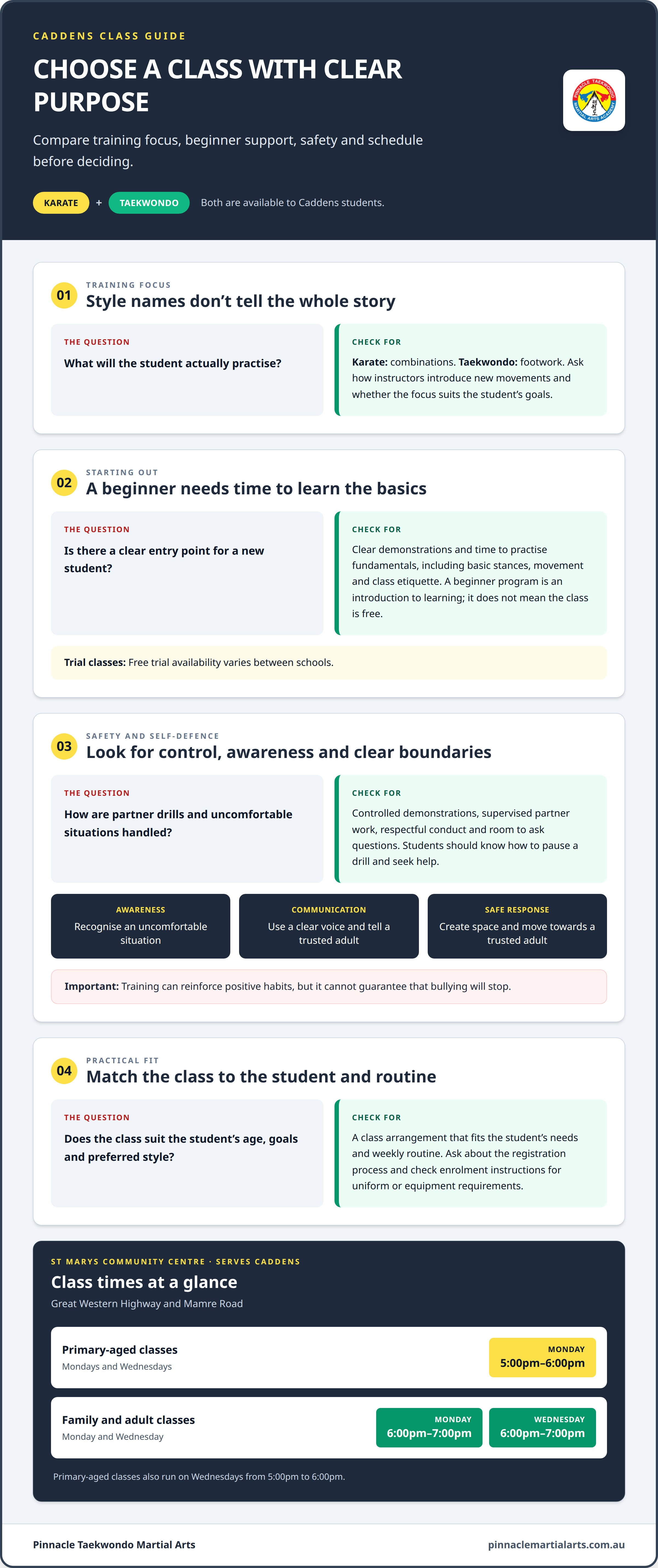
Karate and Taekwondo are both available to Caddens students, but a style’s name alone doesn’t explain how a class is taught. Consider what students practise, such as karate combinations or Taekwondo footwork, and how instructors introduce new movements.
Skill level also shapes the learning experience. Beginners benefit from clear demonstrations and time to practise fundamentals; experienced students need opportunities to refine control and technique. Pinnacle Taekwondo Martial Arts offers both Karate and Taekwondo classes, so consider which training focus best matches the student’s goals.
Trial Classes and Beginner Programs
Free trial availability varies between schools. A beginner program describes an entry point for learning, not whether a class is free. Look for a clear introduction to basic stances, movement and class etiquette, so a new student can understand what training involves before progressing.
Qualifications and safety policies also differ between clubs. Consider how instructors explain their training background, supervise practice and manage partner drills. Clear demonstrations, controlled movement and respectful conduct are useful signs of an organised class; no particular qualification or safety policy applies universally to every Caddens-area school.
To enrol, start by identifying the student’s age group and preferred style, then follow the school’s registration process. New students can wear comfortable clothing for initial movement practice and bring a water bottle. Check the enrolment instructions for uniform or equipment requirements.
Location and schedule matter too. The St Marys Community Centre is at the Great Western Highway and Mamre Road, and serves Caddens. Primary-aged classes run Mondays from 5:00pm to 6:00pm; family and adult classes run Mondays from 6:00pm to 7:00pm and Wednesdays from 6:00pm to 7:00pm. For a closer look at Karate and Taekwondo training, consider how each option fits the student’s routine and goals.
Karate, Tae Kwon Do and self-defence training
Karate and Taekwondo develop physical skills through structured practice. Students work on stances, controlled movement, coordination and responding to an instructor’s directions. A learner might practise a defensive position, then repeat it with improved balance. Self-defence training builds on these foundations with awareness, boundaries and choosing a safe response. The emphasis is on skill and control, not confrontation.
Practical self-defence training connects movement with everyday situations. Students can rehearse using a clear voice, creating space and moving towards a trusted adult. In partner drills, instructors demonstrate controlled actions and explain when to stop. This helps learners understand that physical techniques work alongside communication and awareness, rather than replacing them.
Anti-bullying training is most useful when it teaches responses beyond martial arts techniques. A student might practise saying “stop”, leaving an uncomfortable situation and telling a teacher or caregiver what happened. Discipline supports these choices: learners follow instructions, respect personal space and avoid using class techniques to intimidate others. Training can reinforce these habits, but it cannot guarantee that bullying will stop.
Parents can assess a program by observing how instructors explain boundaries and supervise practice. Look for clear demonstrations, respectful partner work and time for students to ask questions. A child should know how to pause a drill and seek help if they feel uncomfortable. A calm, structured approach makes expectations easier to understand for beginners and experienced students alike.
Karate, Taekwondo and dedicated self-defence classes have related but distinct learning goals. A student focused on technique may prefer practising forms and controlled combinations; someone seeking everyday personal safety may value awareness and boundary-setting exercises. Consider what a typical session covers and how activities suit different learners. This helps families choose a program aligned with the student’s age, confidence and purpose.
Martial arts for kids, teens and adults
Age and experience shape what students need from martial arts training. Children may benefit from learning class routines and basic movement, while teens might want to develop technique, fitness and focus. Adults can work on mobility, coordination and skill at a pace that suits their starting point. The right class gives each student room to practise with purpose.
For families near Caddens, the St Marys centre serves the suburb and offers classes for different age groups. Primary-aged classes run on Mondays from 5:00pm to 6:00pm. Family and adult classes run on Mondays and Wednesdays from 6:00pm to 7:00pm. These sessions give adults a defined training time, while families can consider how a regular class fits around school, work and other commitments.
Teens and adults may have different goals for a class. A teen might focus on mastering a sequence and improving control; an adult beginner may prioritise foundational movements. In either case, steady practice builds skills without treating age as a measure of ability. Choose a class format that suits the student’s experience and goals.
Families training together can share a routine and encourage one another’s progress. A parent and teen, for example, can each focus on a personal technique goal, then talk about what they practised. Students who prefer separate sessions can choose classes suited to their age group. Start with a schedule and training focus the student can maintain.
Planning ahead makes attendance easier. Match the class time to the student’s weekly routine, then allow space for travel to St Marys and preparation before training. For children, after-school care may also help families organise the transition from school to class. Explore martial arts classes for your family and choose a training path that fits each student’s goals.
Pinnacle Taekwondo Martial Arts
Pinnacle Taekwondo Martial Arts offers structured martial arts training for children in Caddens and across Sydney, including Marrickville, Earlwood, Chester Hill, Bankstown, the Inner West and Penrith. If you’re considering classes for a young beginner, Kids Martial Arts provides a starting point for developing movement, focus and confidence. Families can also explore Kids Taekwondo, Kids Kung Fu or Kids Self Defence, depending on the skills their child wants to practise.
These options have different training focuses. Think about whether your child is most interested in martial arts foundations, Taekwondo, Kung Fu or practical self-defence. A clear goal can guide your next step and make the choice more purposeful.
Ready to discuss suitable training for your child? Contact Pinnacle Taekwondo Martial Arts to book one free lesson.
Take the next step towards confident training
Choosing karate classes in Caddens can be the start of a meaningful routine, not a test of existing ability. Begin with the student’s interests and what they hope to practise. A child drawn to movement may enjoy exploring martial arts, while another may be more interested in self-defence skills. Choose a starting point that gives them a clear reason to participate and room to grow.
Pinnacle Taekwondo Martial Arts offers Kids Martial Arts, Kids Kung Fu and Kids Self Defence. These programs give families different ways to introduce structured training and help children build skills through practice. Consider the kind of learning that will keep your child engaged, then take the next step at a pace that feels right for your family.
Contact Pinnacle Taekwondo Martial Arts to discuss a suitable starting point. Every new skill begins with a first step, and your family can take it with confidence.
Frequently Asked Questions
What karate classes are available in Caddens, NSW?
Karate classes in Caddens are available alongside Taekwondo, Kung Fu and self-defence training through Pinnacle Taekwondo Martial Arts. Children can explore Kids Karate and broader Kids Martial Arts programs, while teens and adults can choose among the available martial arts disciplines. For a child who’s unsure where to begin, consider whether they’re more drawn to learning karate techniques, building general martial arts skills or practising self-defence.
Which karate clubs near Caddens offer classes for children and adults?
Pinnacle Taekwondo Martial Arts offers martial arts training for children, teens and adults in Caddens, Marrickville, Earlwood, Chester Hill, Bankstown, the Inner West and across Sydney. Programs include Kids Karate and Kids Martial Arts, along with classes for teens and adults in disciplines such as Karate and Taekwondo. Match each student’s age and interests to the training style they want to pursue.
What are the class times and locations for karate lessons in Caddens?
The St Marys training centre is at St Marys Community Centre, near the Great Western Highway and Mamre Road, and serves Caddens. Primary-aged classes run Mondays from 5:00pm to 6:00pm and Wednesdays from 5:00pm to 6:00pm. Family and adult classes run Mondays and Wednesdays from 6:00pm to 7:00pm. These sessions let families consider whether a weekday class fits their regular routine.
What age can children start karate classes near Caddens?
Children can begin martial arts training from age three through the Mini Rangers program, designed for ages three to six. Older children can progress to the Martial Rangers program for ages seven to twelve. These age groups give families a starting point when considering a child’s readiness for structured instruction. For a younger beginner, look for a class suited to their developmental stage and ability to follow group activities.
What qualifications and safety policies do local karate instructors and clubs have?
Qualifications and safety policies vary between clubs. Ask instructors about their training background, how they supervise practice and manage partner drills, and look for clear demonstrations and respectful conduct.
How do karate schools in Caddens compare by style, price, schedule, and reviews?
Classes serving Caddens include Karate and Taekwondo. At the St Marys centre, primary-aged classes run on Mondays and Wednesdays from 5:00pm to 6:00pm, while family and adult classes run on both days from 6:00pm to 7:00pm.