 0410 686 585

Self-defence is most useful when a child learns to avoid danger, use their voice and get to safety, not to win a fight. Safe martial arts training for children should treat physical skills as a last resort, with escaping and finding a trusted adult as the priority.
It’s understandable to want your child to feel confident and capable while staying safe. Supportive training can build coordination, discipline and awareness, alongside practical skills such as setting boundaries, creating space and asking for help.
This article explains what child-focused self-defence can involve, how martial arts can support confidence and coordination, and what to look for in a supportive training environment. You’ll also learn why age-appropriate teaching, controlled practice and steady encouragement matter as children develop at their own pace.
Key Takeaways
- Understand why self-defence should focus on using only the minimum force needed to get safe.
- See how regular practice can support confidence, discipline and coordination over time.
- Learn to help children notice potential risks and make safer choices.
- Recognise how age-appropriate teaching, controlled practice and supportive instructors can shape a safer training experience.
Is Self-Defense Good for My Child?
Yes. Self-defence can help children practise boundaries, awareness and escape skills. The priority is getting away safely, not winning a fight.
No martial art is automatically safest for every child in Australia. Karate, taekwondo and kung fu can all be taught with controlled contact. Safety depends on age-appropriate instruction, clear behaviour standards and careful supervision of practice.
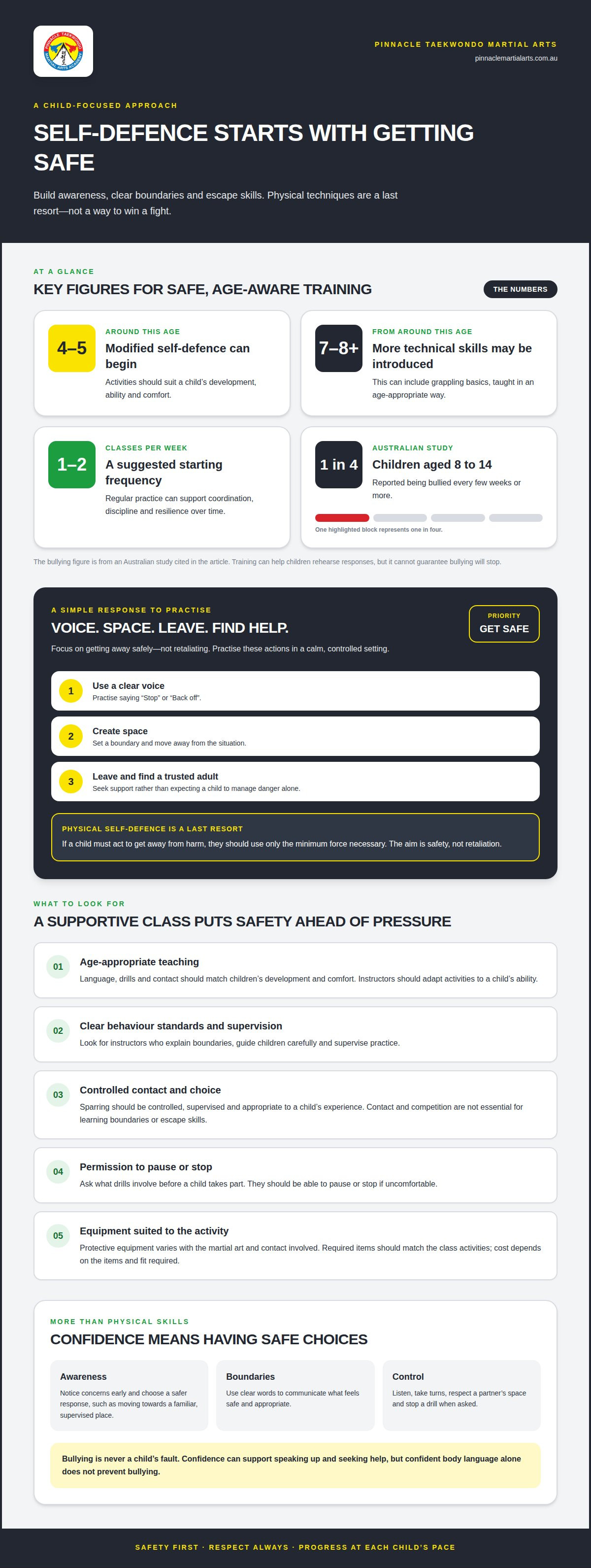
Teach a simple response: use a clear voice, create space, leave and find a trusted adult. Children can practise saying “Stop” or “Back off”, then focus on escaping. Physical self-defence is a last resort. If a child must act to get away from harm, they should use only the minimum force necessary. The aim is safety, not retaliation.
Choosing safe, age-appropriate classes
A suitable class matches its language, drills and contact to children’s development and comfort. Modified self-defence can begin around 4 to 5 years old; more technical skills and grappling basics can be introduced from age 7 or 8 onwards.
In Australia, look for clear behaviour standards, controlled contact and age-appropriate teaching as practical child-safety expectations. Observe how instructors guide children, explain boundaries and adapt activities. A first lesson should account for a child’s ability and comfort. One to two self-defence classes per week is a suggested starting frequency. Regular practice can strengthen coordination, discipline and resilience without making fighting the goal.
Equipment, injury risks and sparring
Protective equipment varies with the martial art and contact involved, so required items should match the class activities. Equipment cost depends on the items and fit required, and is provided after a quote request.
Injury risk varies with contact intensity, falling and technique. Sparring should be controlled, supervised and appropriate to the child’s experience. Contact and competition aren’t essential for learning boundaries or escape skills. Ask what drills involve before your child takes part, and make sure they can pause or stop if uncomfortable. These safeguards help children practise confidently, with safety ahead of pressure to compete.
Confidence, discipline and coordination
Children gain confidence through practice, effort and visible progress, not by learning to intimidate others. A martial arts lesson can bring these skills together through clear routines and achievable challenges.
Confidence and bullying prevention
Confidence can help a child recognise uncomfortable behaviour, speak up and seek support, but it cannot guarantee bullying will stop. An Australian study found one in four children aged 8 to 14 reported being bullied every few weeks or more. Training can help children rehearse practical responses, such as using a firm voice, moving away and telling a trusted adult.
That practice builds options, not blame. Bullying is never a child’s fault, and confident body language alone doesn’t prevent it. A useful class reinforces asking for help alongside physical skills, so children know what to do when a situation feels unsafe.
Discipline and respect
Discipline means following instructions, practising techniques carefully and learning from feedback. Respect gives those habits direction: children listen while others speak, take turns and use movements only as agreed in practice.
For example, a karate drill may ask each student to wait, perform a technique, then reset when instructed. Repeating that sequence helps a child focus under pressure and respect a partner’s space. Progress comes from consistent effort, not from overpowering someone else.
Self-empowerment without aggression
Self-empowerment means knowing you can make a safe choice and ask for help, rather than feeling you must fight. Children can practise a strong stance, clear words and stepping away, while learning that physical techniques aren’t for showing off.
Instructors can praise control as well as effort. A child who stops a drill immediately when asked demonstrates confidence and self-control. That distinction matters: confidence supports firm boundaries, while aggression tries to dominate others.
Coordination through training
Martial arts activities challenge children to coordinate balance, timing and movement. A simple sequence, such as stepping forward, raising a guard and returning to stance, asks a child to listen, move and reset in order.
Repeated drills let children practise these actions at a manageable pace. Boxing-style footwork, for example, involves shifting weight while staying balanced; paired movements can develop awareness of space. Families seeking a structured setting can explore a supportive martial arts training environment where children practise skills with focus and respect.
Safety awareness and recognising potential dangers
Self-defence learning includes noticing concerns early, before a child feels pressured to respond physically. Martial arts classes can develop awareness alongside fitness and movement skills.
Situational awareness
Situational awareness means noticing what’s happening nearby and choosing a safer response. For example, a child walking home from school can stay alert, move towards a familiar, supervised place and tell a trusted adult if something feels wrong.
Good instruction teaches children to recognise potential dangers and avoid them when possible. That might mean leaving an uncomfortable situation rather than staying to see what happens next. These skills support practical judgement, not fear or suspicion of everyone around them.
Parents can reinforce learning with calm, everyday examples. Talk through who your child could approach at school, where a familiar meeting place is and how to get help if separated. Keep the focus on noticing, moving away and seeking support, rather than expecting a child to manage danger alone.
Personal boundaries and verbal commands
Personal boundaries help children recognise and communicate what feels safe and appropriate. Practising a clear “Stop” or “Back off” gives a child simple words to use when someone crosses a boundary or moves too close.
In class, instructors can teach children to use a strong voice, step back and create space. A realistic drill might involve a partner approaching, the child giving a verbal command, then moving towards a safe adult. Rehearsing that sequence makes the response easier to remember under pressure.
Boundaries also mean understanding when to walk away and ask for help. Children should know they can tell a parent, teacher or another trusted adult about unwanted contact. Self-defence learning should never suggest a child is responsible for preventing someone else’s harmful behaviour.
For parents, the key is whether lessons connect awareness to sensible choices. A child should learn to notice, use their voice, leave and seek help. Physical techniques come after those priorities, supporting safer decisions in everyday situations.
Safe and supportive training environments
Safe martial arts training for children depends on clear expectations, age-appropriate teaching and controlled practice. In classes for kids, instructors assess each child’s abilities and comfort during the first lesson, then adapt activities to support safe participation.
Progress should fit the child, not a fixed timetable. Children learn at different rates, so instructors can recognise improvements such as following a new movement sequence or returning to a drill with greater focus. Specific feedback helps children develop without pressure to match another student’s pace.
Class size shapes how closely instructors can guide practice. Individual attention, feedback and clear direction help children practise safely. For example, an instructor can correct a child’s stance during a drill and notice when they need a pause. That support matters when a child feels unsure or is learning a movement for the first time.
Parents can observe how a class runs before enrolling. Notice whether instructors speak respectfully, explain activities clearly and respond calmly when a child needs help. Look at the training area too: clean floors, organised equipment and visible safety measures support a focused environment. A friendly welcome is positive, but consistent supervision and clear behaviour standards matter more.
When assessing safe martial arts training for children, consider the class culture too. Training should reinforce respect and personal boundaries, never encourage students to intimidate others or use techniques outside practice. A child should be able to tell an instructor when they feel uncomfortable and receive a calm response. These cues help parents judge whether the programme supports awareness as well as physical skills.
The takeaway is practical: look for attentive instructors, controlled activities, clean facilities and progress that reflects each child’s comfort. Explore supportive martial arts classes as a structured setting for children to practise with guidance.
Pinnacle Taekwondo Martial Arts: Kids Martial Arts
Pinnacle Taekwondo Martial Arts offers Kids Martial Arts for families seeking structured training that develops confidence, discipline and practical skills. Children can also take Kids Kung Fu, Kids Taekwondo or Kids Self Defence, with age-specific classes designed to help build strength, coordination, focus and self-belief.
These classes are a practical next step when your child is ready to practise movement, build fitness and learn self-defence in a coached setting. Training is dynamic, fun and structured, with respect and safety guiding practice. Choose the programme that best matches your child’s interests and the skills you’d like them to develop.
Contact Pinnacle Taekwondo Martial Arts to discuss Kids Martial Arts and book your child’s first lesson.
Take the next step with confidence
Choosing safe martial arts training for children starts with matching the class to your child’s interests and readiness. Notice what helps them feel engaged: learning a new movement, practising with a partner or building confidence through a familiar routine. Their response can guide your next conversation and help make training a positive choice for your family.
Pinnacle Taekwondo Martial Arts offers Kids Martial Arts, Kids Kung Fu and Kids Self Defence. Each provides a way for children to explore structured training and develop practical skills. Consider which option best fits what your child wants to learn, then discuss a suitable starting point with the team.
Contact Pinnacle Taekwondo Martial Arts to talk about training for your child. A thoughtful first step can open the door to new skills, stronger self-belief and progress your child can feel proud of.
Frequently Asked Questions
What age can children start martial arts classes in Australia?
Children can start martial arts at age 3 in Pinnacle Taekwondo Martial Arts’ MINI RANGERS (3-6 years) programme. Modified self-defence can begin around 4 to 5 years, while more technical skills and grappling basics can be introduced from age 7 or 8 onwards. Readiness also depends on whether a child can follow instructions and participate comfortably.
What qualifications and first aid training should children’s martial arts instructors have?
Ask instructors about their martial arts training, experience teaching children and first aid preparation. Find out how they would respond if a child were hurt, who would supervise the rest of the class and how they would communicate with parents. Clear, practical answers help you understand how an instructor handles safety alongside teaching, while recognising that each discipline and class has its own needs.
How can parents assess a martial arts school’s safety, supervision, and class size?
Observe a class in Sydney and notice whether instructors can see students during drills, correct unsafe movements and respond when a child needs help. Watch how students move between activities and whether equipment or other people obstruct the training space. A smaller class can allow more individual feedback; look for signs that each child receives attention rather than being left to copy others.
What questions should parents ask before enrolling a child in martial arts?
Ask what a beginner’s first lessons involve, how contact or sparring is introduced, and how a child can pause an activity. Clarify which equipment is needed and how instructors adapt drills for different comfort levels. Explain your child’s interests or concerns, then ask how lessons support those needs. These details help you judge whether the class suits your family.
What safety standards and child protection rules apply to martial arts schools in Australia?
Look for clear behaviour standards, controlled contact and age-appropriate teaching. Observe how instructors supervise children, explain boundaries and adapt activities to each child’s abilities and comfort.
What are the injury rates and common risks in children’s martial arts?
Injury risk varies across training formats. It changes with contact intensity, falling and technique. Sparring should be controlled, supervised and appropriate to the child’s experience.