 0410 686 585

Confidence isn’t a prerequisite for martial arts; it’s something children can practise. Martial arts for kids who lack confidence can help children notice their progress through achievable skills, repetition and positive feedback, while offering a structured way to move and learn.
It makes sense to want more than physical training. You want your child to feel safer, speak up when needed and know how to respond if someone treats them badly. Classes can teach age-appropriate self-defence and ways to avoid or respond to conflict, but they can’t guarantee protection from bullying.
This guide explains how martial arts practice may support everyday confidence, what responsible bullying-prevention and self-defence teaching involves, and how to consider your child’s age and schedule. It also covers why a good fit depends on your child’s interests and how the class is taught. Small steps matter: a welcoming, well-structured class gives children room to try, learn and grow at their own pace.
Key Takeaways
- Look for a supportive teaching environment where instructors encourage effort and children can practise with others.
- Help your child notice personal progress through small, achievable goals and repeated practice.
- Effective self-defence teaching puts avoiding conflict and using words first, with physical defence as a last resort.
- Many schools welcome children from around 4 or 5 years old, and class schedules can help shape a routine that suits your family.
What About Other Martial Arts?
Karate, Taekwondo and Kung Fu use different movements and teaching approaches, so the right fit depends on your child’s interests and the class culture. Physical training carries some injury risk. Supervised, controlled drills and clear instructions help children practise more safely.
Choosing a Safe, Supportive School
A supportive school provides clear instruction, attentive supervision and respectful correction. Observe a class and notice how instructors guide children. Are partner drills organised? Can children understand the instructions and pause to ask for help? A calm correction after a missed movement, for example, gives a nervous beginner room to learn. Ask how practice is adapted for beginners and how instructors respond when a child feels uncomfortable.
Inclusive Group Classes
Inclusive group classes let children practise alongside peers without making confidence a competition. Partner exercises and group drills can develop cooperation and communication as well as movement. A child might practise a stance with a partner, then join a shared sequence with the class. Look for respectful treatment across experience levels. The aim is participation and effort, not keeping pace with the fastest student or performing perfectly at the first attempt.
Progress with Group Support
Individual progress can remain central while classmates offer encouragement and structure. Instructors can set a reachable next step, revisit a familiar skill and recognise a child’s effort as a movement improves. Specific feedback makes progress visible without inviting comparisons. Group practice also teaches children to take turns, listen and support a partner. Karate is generally non-competitive unless students take part in a tournament, so ask how the school balances personal goals with competitive activities.
Confidence through personal progress and achievement
Karate, taekwondo and Brazilian jiu-jitsu can help children build confidence through skill practice, physical challenges and personal milestones. Martial arts for kids who lack confidence can make progress easier to notice through achievable goals and steady effort. For a shy child, repeating movements, receiving positive feedback and practising with a partner can make participation feel more familiar.
Progress and Achievement
Personal progress means recognising a skill a child can do now that once felt difficult. This helps students measure growth against their own starting point, rather than another child’s performance. After a session, choose one small goal together: remember an instruction, join the warm-up or ask the instructor for help. Each achievable step gives effort a purpose and makes improvement easier to notice.
Confidence Through Repetition
Repetition helps children practise a movement until its steps feel more familiar. In Karate, a student might review a stance, practise a block and combine them in a short sequence. Instructors who revisit familiar skills help children retain what they’ve learned. Specific feedback, such as recognising a steady stance, shows what’s working and gives a shy beginner a clear next step.
Partner practice can also ease social pressure. A child might take turns practising a movement with one classmate before joining a group drill. The shared task gives them a reason to communicate, listen and cooperate without having to lead a conversation. Supportive guidance helps students practise respectfully and complete the exercise together.
Karate can give children a setting to practise without worrying as much about other people’s opinions. Learning a challenging movement, trying again after a mistake and noticing progress can help a child feel more capable. Parents exploring martial arts for kids who lack confidence can look for classes where instructors recognise effort and build on skills children already know.
Explore how kids’ karate classes can make structured practice part of a child’s confidence-building journey.
Bullying prevention and self-defence
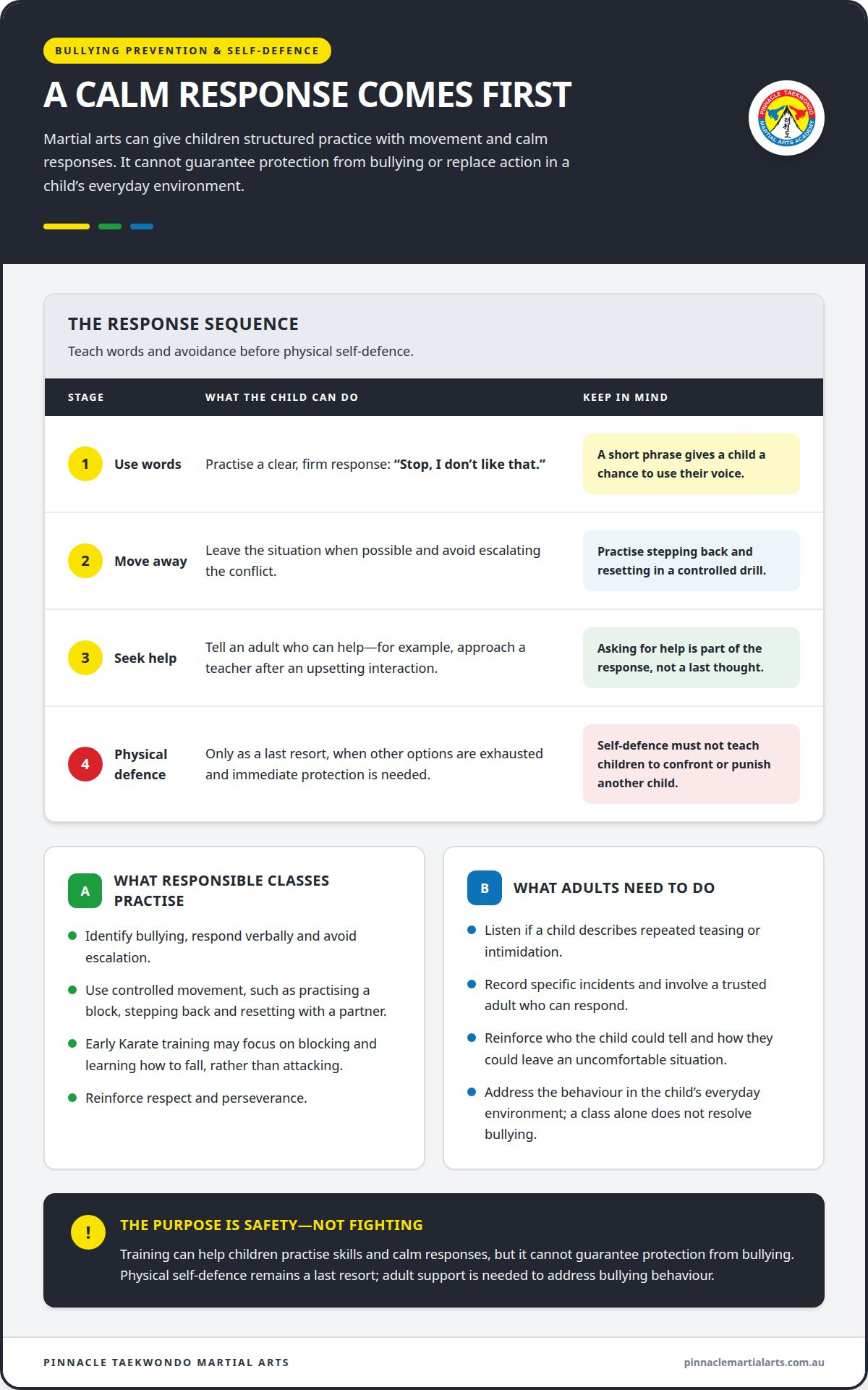
Martial arts can help children develop practical skills and practise calm responses, but training alone doesn’t resolve bullying. If your child describes repeated teasing or intimidation at school, listen, record specific incidents and involve a trusted adult who can respond. A class can support learning, but it can’t replace action in the child’s everyday environment.
Teach a clear response sequence: use words first, move away when possible and seek help from an adult. A child might say, “Stop, I don’t like that,” then leave and tell a teacher. Good instruction reinforces avoiding conflict. Physical self-defence is a last resort, only when other options are exhausted and immediate protection is needed.
Karate can help children become familiar with controlled movement without presenting fighting as the answer to bullying. A beginner might practise a block, step back and reset with a partner. Early Karate training may focus on blocking and learning how to fall, rather than attacking. These skills provide structured practice, while instructors can reinforce respect and perseverance.
Worries about bullying can leave children feeling powerless or reluctant to speak. Rehearsing a short, firm response in class gives them a chance to practise using their voice. Instructors can also model asking for help, such as approaching a teacher after an upsetting interaction. These examples connect physical learning with actions a child can use to seek safety.
Self-defence should never encourage a child to confront or punish another child. Instructors who teach children to identify bullying, respond verbally and avoid escalation keep the purpose clear. Parents can reinforce the same message by asking what the child learned, who they could tell at school and how they would leave an uncomfortable situation. Training builds skills; adults must address the behaviour.
Class duration and age-appropriate training
Children need classes that match their development, attention and family routine. Many martial arts schools welcome children from around 4 or 5 years old, with programs adapted for younger students. Most instructors recommend two to three classes per week. That’s a guide, not a reason to overload a beginner’s schedule.
Class duration can affect how comfortably a child stays engaged, but the session’s structure matters too. A well-paced class makes room for warm-up, instruction, physical practice and changes of activity. A younger beginner, for example, may respond well when an instructor explains and demonstrates one movement, then gives students time to practise. Participation supports strength and fitness, while clear transitions help children follow along.
At a first class, expect an introduction to the instructor, basic movement and simple directions. Your child may watch before joining in, especially in an unfamiliar room. They don’t need to master a technique straight away. Notice whether the instructor explains activities clearly and gives beginners time to try. The session can show how the class balances structure with encouragement.
Interest matters, too. A class that varies movement, practice and partner activities may hold a child’s attention better than one that repeats a single drill throughout. Ask your child what felt enjoyable or difficult afterwards. Their answer can show whether the activities sparked curiosity, supported friendships or felt overwhelming.
Assess fit by considering your child’s experience over time. Do they understand the instructions, feel comfortable taking part and leave with a sense of achievement? If they repeatedly find the class distressing, consider another group or activity. Confidence and self-esteem need room to grow; perseverance shouldn’t mean pushing through ongoing distress. Choose a routine that works alongside school, rest and family commitments.
Explore kids’ martial arts classes and find a structured starting point for your child.
Pinnacle Taekwondo Martial Arts
Pinnacle Taekwondo Martial Arts offers children’s martial arts programs for families considering structured training to support confidence and practical skills. Kids Martial Arts, Kids Kung Fu, Kids Self Defence and Kids Taekwondo offer different ways to explore movement, discipline and self-protection. The best starting point depends on your child’s interests and the skills you hope they’ll practise.
If your child is ready to try a class, or you’re weighing up which option suits their needs, contact Pinnacle Taekwondo Martial Arts to discuss the next step.
Make the next step feel achievable
Confidence often shows in small choices, not a sudden change in personality. A child might first watch from the edge, then join the warm-up, try a new movement or speak up when they need help. Notice these efforts, even when progress is gradual.
For children who feel unsure, martial arts for kids who lack confidence can offer a structured place to practise effort and resilience. Keep the next step manageable. Ask what they’d feel comfortable trying, then use their answer to guide a conversation about classes. If bullying or anxiety affects their wellbeing, training can complement appropriate support, not replace it.
A thoughtful start begins with understanding what your child hopes to gain and what feels challenging. Start a conversation with Pinnacle Taekwondo Martial Arts about a suitable next step. Progress begins with trying.
Frequently Asked Questions
What Should A Supportive Coach Do?
A supportive coach gives clear instructions and corrects mistakes without shaming a child. They recognise effort, explain what to adjust and welcome questions. If a child freezes during a new drill, for example, the coach can demonstrate it again and invite them to try at a comfortable pace. That response makes feedback useful rather than intimidating.
What age can children start martial arts in Australia?
Many Australian martial arts schools welcome children from around 4 or 5 years old, with programs adapted for younger students. Some begin earlier: Pinnacle Taekwondo Martial Arts has its Mini Rangers program for ages 3-6 years. A child’s readiness also depends on whether they can take part in simple group instructions and feel comfortable in the class environment.
How to choose a safe martial arts school for a child in Australia?
Look for calm, organised instruction and close supervision during practice. Observe how the instructor manages transitions, corrects unsafe movement and responds when a child needs a break. Ask how partner activities are matched and adapted for beginners. A safe environment makes expectations clear, treats children respectfully and lets them raise concerns without embarrassment.
Which is better for confidence: karate, taekwondo, judo, or Brazilian jiu-jitsu for kids?
No style is automatically best for every child; interest and teaching approach matter. Karate is generally non-competitive unless students enter a tournament, while Brazilian jiu-jitsu often introduces live rolling early. These differences can shape a child’s experience. Consider whether your child prefers structured individual techniques or close partner-based activity, then weigh that preference against the class environment.
How to find a beginner-friendly kids’ martial arts class near me in Australia?
Look for beginner-friendly classes that explain how children are introduced to training. For families in Sydney, Pinnacle Taekwondo Martial Arts serves Marrickville, the Inner West, Earlwood, Canterbury, Chester Hill, Bankstown, Caddens and Penrith. Its kids’ programs include a free trial lesson, so your child can experience a class before deciding whether it feels like a good fit.
How to tell if a martial arts class is helping a child’s confidence?
Look for changes beyond technique. Your child might enter class more readily, ask an instructor to clarify something or recover more comfortably after a mistake. Notice whether they speak positively about a classmate or volunteer to try an unfamiliar activity elsewhere. These everyday signs can help you tell whether training feels encouraging and your child is gaining confidence at their own pace.