 0410 686 585

A belt marks progress, but it isn’t a stopwatch. Martial arts belt progression coaching helps students develop the skills, fitness and knowledge needed for each grading. Promotion depends on readiness, not attendance alone. Belt colours and their order vary between martial arts styles and schools.
It’s natural to want a clear timeline, especially when you or your child is working towards the next belt. In Karate and Taekwondo, earning a black belt may take 3-5 years; across martial arts, the typical range is 5-10 years, depending on the discipline and individual progress.
This guide explains what progression means, how belt colours mark development, and how attendance can support preparation for grading. You’ll also learn what instructors assess and why steady practice, patience and effort matter more than rushing to the next colour. Each step can build skill, confidence and discipline.
Key Takeaways
- Use attendance guides as a planning tool, while recognising that class requirements can differ by age group and belt level.
- Think of earning a black belt as the start of deeper learning, not the end of training.
- Learn why belt colours and grading sequences differ between martial arts styles and schools.
- Understand how progression tracks skill development, while rank reflects a student’s place within a grading system.
Attendance requirements for pre-testing
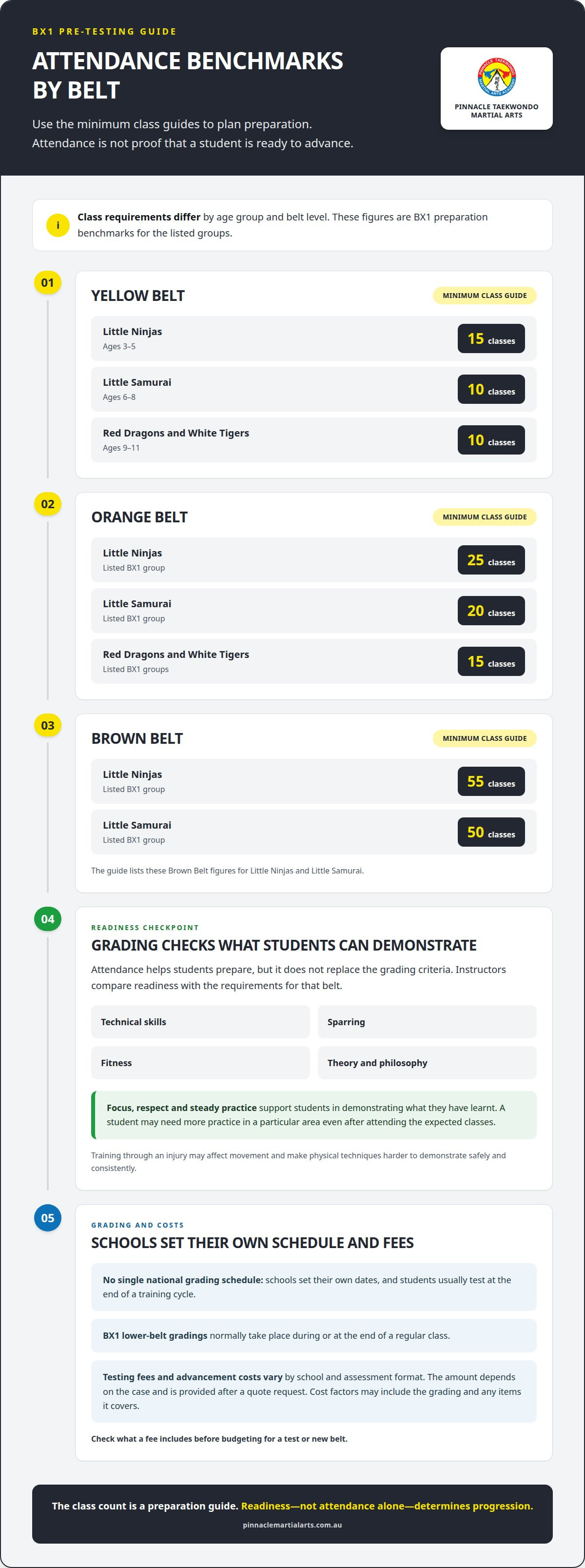
Attendance guides help students build familiarity before a belt test, but they don’t replace grading criteria. The BX1 class guides show how minimum attendance can differ by age group and belt level. Treat each figure as a preparation benchmark, not proof that a student is ready to advance.
For the listed BX1 groups, the minimum class guides are:
- Yellow Belt: 15 classes for Little Ninjas aged 3-5; 10 classes for Little Samurai aged 6-8; and 10 classes for Red Dragons and White Tigers aged 9-11.
- Orange Belt: 25 classes for Little Ninjas; 20 for Little Samurai; and 15 for Red Dragons and White Tigers.
- Brown Belt: 55 classes for Little Ninjas and 50 for Little Samurai.
How often do martial arts schools hold belt gradings in Australia? There’s no single national schedule. Schools set their own grading dates, and students usually test at the end of a training cycle. BX1 lower-belt gradings normally take place during or at the end of a regular class.
Attendance helps students prepare, while grading assesses what they can demonstrate. An assessment may cover technical skills, sparring, fitness, and knowledge of theory and philosophy. Instructors compare a student’s readiness with the criteria for that belt. Even after attending the expected classes, a student may need more practice in a particular area before promotion.
Belt testing fees and advancement costs vary with the school and assessment format. The amount depends on the case and is given after a quote request; cost factors may include the grading and any items it covers. Ask what the fee includes before budgeting for a test or new belt.
Attitude and effort matter alongside technique. Focus, respect and steady practice help students demonstrate what they’ve learned and build confidence. Rushing can leave gaps in skill and readiness. Training through an injury may affect movement and make it harder to demonstrate physical techniques safely and consistently.
How Long Does It Take to Get a Black Belt?
Earning a black belt can take years of consistent training. The timeline depends on the martial art, training frequency and personal readiness.
Junior Belts, Stripes and Black Belt Degrees
Junior belts mark progress towards black belt, while stripes can show advancement within a belt colour. For example, a student might earn a stripe on a green belt while developing particular skills. These markers give children clear goals between gradings, but their meaning and use vary between schools. After black belt, degrees, also called dans, indicate further mastery and contribution to the art.
Black Belt as a Transition
A black belt marks a transition to deeper learning, not a finish line. Students continue refining techniques, building control and learning about their discipline. The rank recognises achievement, while ongoing training develops the knowledge and judgement needed to use skills responsibly. Readiness matters more than reaching a particular colour quickly.
Across martial arts, earning a black belt typically takes 5-10 years of consistent training. Karate and Taekwondo students may take 3-5 years, while a Brazilian Jiu-Jitsu black belt typically takes 8-15 years. These ranges differ because disciplines have distinct grading structures and expectations. Traditional Karate commonly includes 8 to 10 kyu grades before black belt, with each grading providing another opportunity to demonstrate progress.
For children, junior ranks can make long-term progress feel manageable. A stripe or green belt can mark an interim milestone, while instructors assess readiness for promotion. Sparring may be part of training and grading, alongside techniques and other criteria. Promotion isn’t automatic after a set period: students earn it by meeting the requirements for their level.
A black belt can support personal development, but it doesn’t by itself prepare someone for a martial arts career. Teaching or coaching also calls for communication, responsibility and experience supporting other students. Anyone interested in that path can treat the rank as a foundation for further learning. Consistent practice builds skills that matter inside and beyond the training space.
Focused feedback can help students understand their next development goals. Explore martial arts training as one way to keep learning.
Belt colours and their progression
A belt colour gives students a visible marker of progress, but it isn’t a universal ranking code. Karate and Taekwondo use coloured belts, while each style and school can set its own sequence and grading expectations.
Jigoro Kano’s original belt system used two colours: white and black. White distinguished beginners, while black marked experts. Later colour systems created more milestones between those stages. In Taekwondo, the progression is described through 9 to 10 geup grades before black belt. Karate commonly uses kyu grades before its dan ranks, though the colour assigned to each grade depends on the school.
That variation matters. A yellow belt in one school may not represent the same rank, syllabus or readiness as a yellow belt elsewhere. The colour identifies a student’s place within that school’s system, not their ability across different martial arts or clubs.
Colour symbolism can make progress meaningful, but meanings aren’t fixed across disciplines. White may represent a beginner’s starting point in Kano’s system, while black distinguishes the expert level there. Other colours, such as yellow or green, may mark intermediate stages, but their meanings depend on the school’s teaching framework. Follow the system being taught rather than assuming every colour has a universal meaning.
A structured sequence gives students clear milestones. For example, a school might organise training around a syllabus for each belt, then assess whether students can demonstrate its techniques. The next colour represents progress through that syllabus, not simply time spent in class. Grading criteria connect each rank with the skills and knowledge students need to develop.
Before comparing belts, identify the martial art and the school’s grading structure. In Karate, ask which kyu grade a colour represents; in Taekwondo, check its place among the geup grades. This makes progress easier to understand, especially when students change schools or styles. A belt guides learning within its system, while consistent practice builds the skill behind it.
Karate uses kyu grades before dan ranks, with belt colours and grading expectations varying by school. Taekwondo has 9 to 10 geup grades before black belt; judo’s original system used white for beginners and black for experts, with later colour systems adding milestones. Grading can assess whether students demonstrate the techniques in their belt’s syllabus.
What Is Martial Arts Progression?
In Australia, progression combines continued learning with movement through a school’s grading structure. Rank shows a student’s position within that structure.
Progression and Rank
Progression is the development of skills, techniques, fitness and discipline through training. Rank is the formal grade a student has earned. The distinction matters: a belt marks a milestone, but learning continues between gradings. Instructors assess readiness against promotion requirements, so effort and improvement matter alongside the colour worn.
Kyu and Dan Rank Progression
Kyu ranks count down from 10th Kyu to 1st Kyu, while dan ranks begin at 1st Dan, or Shodan, and count upwards. In traditional Karate, students commonly pass through 8 to 10 kyu grades before black belt. This sequence helps students understand where they sit in the system and what progression comes next.
Lining Up by Rank
Some classes line students up by rank, with higher grades ahead of beginners. This convention helps instructors organise practice and identify groups working on different techniques. It can also make progression visible to students. The order is a class-management practice, not a measure of personal worth or a substitute for respectful conduct.
Differences Across Styles and Organisations
Systems differ by martial art and organisation, so belt colours and grading criteria aren’t universal. Karate commonly uses kyu and dan ranks; Taekwondo has 9 to 10 geup grades. Judo and Brazilian Jiu-Jitsu follow their own grading frameworks, with requirements set by their respective organisations and schools. Across styles, testing can assess skills, sparring, fitness and knowledge.
Australian rules for instructor qualifications and student safety are separate from belt rank. A belt alone doesn’t establish a teaching qualification; safe practice depends on supervision and attention to technique, fitness and readiness. For practical training in Karate or Taekwondo, explore martial arts classes.
Pinnacle Taekwondo Martial Arts: Private one-to-one coaching
Pinnacle Taekwondo Martial Arts offers private one-to-one coaching for students seeking focused support with their training goals. It can suit someone who wants extra guidance on techniques, confidence or grading preparation. Individual coaching complements regular practice by giving students time to work on specific skills at their own pace.
For families, Kids Martial Arts, Kids Kung Fu and Kids Self Defence offer structured ways for children to develop discipline, fitness and practical skills. The right focus depends on the student’s interests and training goals.
Whether you’re starting out or refining your skills, contact Pinnacle Taekwondo Martial Arts to discuss your training goals.
Make your next training goal count
Your next step doesn’t need to be a new belt. Choose a skill to strengthen, a habit to build or a personal goal that keeps training meaningful. A clear focus can make each class purposeful and help you recognise progress beyond the colour around your waist.
For children, Kids Martial Arts, Kids Kung Fu and Kids Self Defence offer structured ways to develop through training. Adults and families can use martial arts belt progression coaching to keep goals grounded in steady effort, rather than pressure to advance quickly. The best goal supports consistent learning and fits the student’s needs.
Ready to take a practical next step? Contact Pinnacle Taekwondo Martial Arts to discuss training goals and find a focus for your next stage. Keep showing up, keep learning and take pride in the work you put in.
Frequently Asked Questions
How long does it take to progress through martial arts belts?
Progression time depends on the discipline, consistency of training, grading schedule and readiness for each level. Effective martial arts belt progression coaching keeps development centred on learning, not pressure to advance quickly. After a break, an instructor can identify which foundations need attention. Set a manageable practice goal between classes, then build on it as skills become more consistent.
What skills, techniques and fitness are assessed at each belt grading?
Assessment depends on the belt level and school syllabus. Instructors may consider how accurately a student performs required techniques, follows directions and applies control during partner work. Fitness may also form part of the grading. Before testing, focus on listening closely to instructions and performing each movement with care, rather than rushing to finish first.
How much do martial arts belt gradings and coaching cost in Australia?
There’s no single fee for gradings or coaching across Australia. Costs depend on the assessment and coaching requested, and the price is given after a quote request. Keep regular class tuition, grading charges and equipment purchases as separate budget items. This makes it easier to understand what each cost covers and plan for training without assuming every school uses the same fee structure.
How can a martial arts coach help students prepare for belt grading?
Good martial arts belt progression coaching turns grading expectations into clear practice priorities. A coach can run a mock assessment, observe how a student responds to instructions and give feedback on composure between movements. Students can practise recovering calmly after a mistake instead of losing focus. Parents can support preparation by recognising steady effort, not only the grading result.