 0410 686 585

A whole family can enjoy karate, but whether everyone trains together depends on the class format. Kids’ karate classes in Sydney give children a focused way to practise movement, discipline and confidence. For family training, look for a format that suits each person’s age and experience.
It’s understandable to want one activity that brings the family together while helping children stay active and build everyday confidence. Karate offers structured practice and clear opportunities to develop focus, fitness and character, one step at a time.
This guide explains what family class options can look like, what to consider when exploring locations across Sydney and New South Wales, and how karate training can support children’s growth. You’ll also learn how to choose a class format that fits your family’s goals and makes starting feel straightforward.
Key Takeaways
- Find out what to consider when choosing a family training format that suits both children and adults.
- Explore how location and class structure can shape your search across Sydney and New South Wales.
- See how regular karate practice can encourage focus, fitness, confidence and positive character habits.
- Discover how Pinnacle Taekwondo Martial Arts’ kids’ martial arts options can support your family’s training goals.
What are the benefits of training in karate?
Karate can help children practise focus and discipline through clear instructions, repeated movement and respectful group routines. Sydney instructors should explain their karate qualifications, experience teaching children and approach to supervision. Parents can also ask about staff screening and the class’s child-safety procedures before enrolment.
Learning a sequence gives children a practical focus task: listen, remember each movement, then perform it with control. For example, a beginner might practise a stance, a hand technique and a safe return to position. Encouraging steady effort teaches discipline without making progress depend on winning. Children also learn to wait their turn, follow instructions and respect training partners. These habits can support learning beyond the training space.
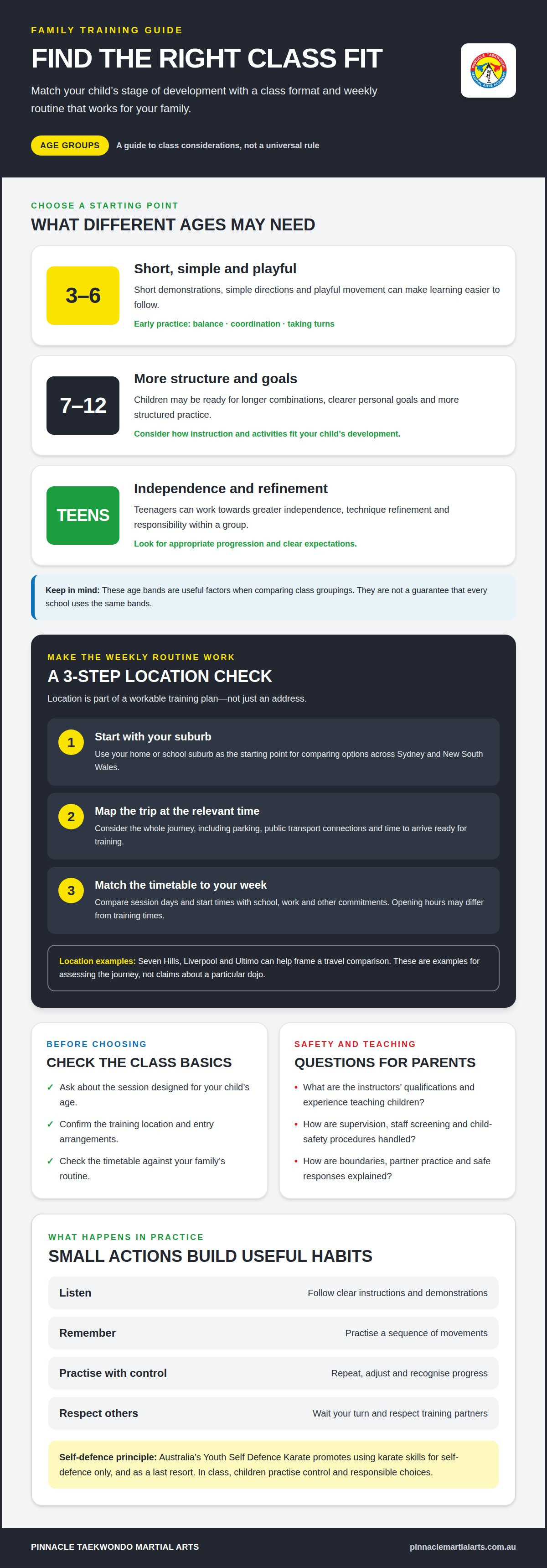
Age-specific classes can match instruction and activities to children’s development. For children aged 3 to 6, short demonstrations, simple directions and playful movement can make learning easier to follow. A class can build familiarity with balance, coordination and taking turns before introducing more complex sequences. Children aged 7 to 12 may be ready for longer combinations, clearer personal goals and more structured practice. Teens can work towards greater independence, technique refinement and responsibility within a group. These are useful factors when considering class groupings, not a guarantee that every school uses the same age bands.
For every age, good teaching makes self-defence about awareness, control and responsible choices. Australia’s Youth Self Defence Karate promotes using karate skills for self-defence only, and as a last resort. That principle keeps physical skills in perspective: children practise control in class, while parents reinforce calm decisions outside it. Look for clear explanations of boundaries, partner practice and safe responses. In a well-structured session, young students know when to practise, pause and listen. Focus grows through repetition; confidence develops as children recognise their progress.
Karate class locations across Sydney and New South Wales
For Sydney families, the most useful location is one that fits the weekly school, work and travel routine. Start with your home or school suburb, then map the trip to the dojo at the time you’d travel. A class nearby can make regular attendance easier to organise, while a longer cross-city trip may affect which session suits your family. Across New South Wales, travel distance matters even more for families outside metropolitan Sydney. Location is part of a workable training plan, not just an address.
Seven Hills and Liverpool are useful examples when comparing options across Sydney. A family in Seven Hills might prioritise a venue near its usual commute; a Liverpool household may favour a class that fits around school collection. These examples describe how to assess location, not a claim that a particular dojo operates in either suburb. Consider the whole journey, including parking, public transport connections and the time needed to arrive ready for training. A dedicated martial arts class only works for family life when getting there is manageable.
Ultimo offers another clear location example for city-based families. Check how the trip fits with school, work and other commitments, rather than judging distance alone. Then compare the dojo’s timetable with your family’s weekly routine. Session days and start times affect whether children can attend consistently, especially when parents coordinate multiple activities. Trading hours and class times are not always the same: the venue’s opening hours may differ from the actual training schedule.
Before choosing, use a simple three-step check: identify the suburb, map the journey at the relevant time, and match the class timetable to your week. Ask about the training location, entry arrangements and the session designed for your child’s age. These details help parents plan ahead and understand what to expect on arrival. If you’re considering a Sydney-based karate training option, use location and timetable fit as practical starting points for your family.
Fitness, confidence and character development
A structured karate programme can bring physical activity and personal growth together. Notice how each session balances movement, practice and respectful interaction.
Confidence, discipline and self-respect
Confidence grows through achievable steps, such as learning a stance, practising a sequence and performing it with control. Discipline appears in the routine: arriving prepared, listening to instructions and continuing when a technique needs more practice. Look for instructors who recognise effort and explain corrections respectfully. These habits help students value their progress while showing respect to classmates.
Focus and self-esteem
Focus is practised each time students follow a demonstration, remember a movement and respond to the next instruction. For example, a child can concentrate on completing a short combination before moving to another task. Recognise effort and improved control, not comparison with classmates. This approach can support self-esteem by helping children see the skills they develop through learning and persistence.
Karate training also gets the body moving. Repeating controlled techniques, changing direction and maintaining balance bring physical activity into a structured class. The demands depend on the exercises and each student’s participation. Look for a programme that develops skills progressively, with clear instructions and practice suited to the group. A steady routine can make fitness part of a child’s week.
Character develops in small moments. Students practise taking turns, respecting training partners and responding calmly when a movement is difficult. Resilience can mean trying again after losing balance, then adjusting technique following feedback. These examples matter at school, too: listening to instructions, cooperating in group tasks and persisting with a challenge. Karate doesn’t replace school or family guidance, but it provides another setting to practise these behaviours.
Kids’ karate classes in Sydney
Choosing a class means looking beyond the suburb and session time. For children in Sydney, useful details include the teaching style, group expectations and how beginners are introduced to skills. A supportive class makes instructions clear, gives students room to practise, and treats respect as part of training. Parents can observe whether children understand how to start, pause and take turns.
Karate is a Japanese martial art, and classes may introduce traditions such as bowing and respectful conduct. These customs should have a clear purpose for children: showing attention, acknowledging training partners and preparing to learn. A first-session routine might include listening to the instructor, following a simple movement demonstration and waiting for a turn. This structure helps young students understand what participation looks like.
Parents can stay and watch Australia’s Youth Self Defence Karate classes. Observing gives families a direct view of how instructors communicate, organise practice and support children as they learn. Look for clear explanations, calm corrections and activities suited to the group. Self-defence should be taught responsibly: Australia’s Youth Self Defence Karate promotes using karate skills for self-defence only, and as a last resort. This principle keeps safety and judgement central.
Family training needs its own practical conversation. A parent and child may share an interest, but age, experience and class format shape whether they train together or separately. Ask how a class handles mixed abilities and what a child’s first session involves. Then consider whether the timetable and location work for the family’s regular routine. For a focused start with kids’ karate training in Sydney, explore the class options that fit your child’s learning goals.
Pinnacle Taekwondo Martial Arts
Pinnacle Taekwondo Martial Arts helps families explore structured martial arts training for children. Its kids’ options include Kids Karate, Kids Martial Arts, Kung Fu, self-defence and Taekwondo. Children can develop movement skills, focus and confidence through guided practice in a dynamic, fun and structured setting.
Consider regular training when your family wants a clear routine or your child is ready to try a new physical activity. A good starting point suits your child’s interests and your family’s schedule. Contact Pinnacle Taekwondo Martial Arts to discuss your child’s goals and book your one free lesson now!.
Make your family’s next step count
Before choosing a class, talk as a family about what your child wants from training. A simple goal, such as feeling more comfortable trying a new activity or practising with a parent, gives the first session a clear purpose. Focus on showing up, learning and enjoying the process. Progress starts with that commitment, not with having every answer before you begin.
Choosing kids’ karate classes in Sydney can start a shared routine, even if family members train at different levels or times. Let your child have a voice in the decision. Their interest can help turn a new activity into a positive habit, while your encouragement helps them stay engaged as they learn.
Ready to take that first step? Contact Pinnacle Taekwondo Martial Arts to discuss a suitable starting point for your family. Back your child’s effort, celebrate each step forward and build momentum together.
Frequently Asked Questions
How long will it take to reach Black Belt level?
Black Belt progression comes through continued training and demonstrated skill, not a fixed calendar date. A student’s pathway reflects attendance, practice between classes and development across techniques. Learning a sequence with control is one part of progress; applying feedback and maintaining consistent effort also matter. Set a personal goal around steady learning rather than comparing your child’s progress with another student’s timeline.
What are your class sizes?
Sessions have 6-8 masters on the floor at every session. That describes the number of masters present, not the student headcount or class size. For family planning, consider how your child learns in a group and whether they feel comfortable following instruction alongside other students. A parent can also discuss the child’s experience level and learning needs as part of choosing a suitable class.
What can I expect at my first class?
Expect structured martial arts instruction in a dynamic, supportive setting. Sessions include a blend of Taekwondo, Karate, Kung Fu, Kickboxing, Boxing, Hapkido and practical self-defence. Your child can focus on following the instructor’s directions and becoming familiar with the training environment. Comfortable, movement-friendly clothing helps them take part, while arriving ready to listen gives the first session a clear starting point.
What are the best kids karate classes in Sydney?
The best fit is a class that matches your child’s age, interests and learning needs. Families comparing kids’ karate classes in Sydney can consider whether instruction is structured, children receive guidance and the training supports their goals. Pinnacle Taekwondo Martial Arts offers Kids Karate alongside Kids Martial Arts, Kids Kung Fu and Kids Self Defence. Choose an approach your child is motivated to practise consistently.
Which Sydney karate schools offer classes for different age groups and skill levels?
Pinnacle Taekwondo Martial Arts has age-specific programs: MINI RANGERS (3-6 years), MARTIAL RANGERS (7-12 years), TEEN’S MARTIAL ARTS (13-18 years), and ADULT’S MARTIAL ARTS (age 18+). The overall programme is for students from age 3 and up. These groupings give families a clear starting point for matching a student’s age with an appropriate training pathway.
Where are children’s karate classes located across Sydney, and what are their timetables?
Children’s classes serve Marrickville, Inner West, Earlwood Canterbury area, Chester Hill Bankstown area South West & Penrith area Western Sydney. Find a session that fits your family’s routine, considering the class day and travel time. For example, allow for the journey from school or work before choosing a regular training day. A realistic weekly plan can support consistent attendance.