 0410 686 585

The best style for building confidence isn’t simply the one with the most dramatic techniques. Confidence grows when children notice their own progress: learning a skill, practising it and applying it with more control. That’s how martial arts build confidence in children, through achievable milestones and visible effort rather than pressure to outperform others.
Parents often want an activity that offers structure and helps their child feel capable. Supportive instruction, clear goals and encouragement can help children take on challenges at their own pace. Regular practice also gives them opportunities to develop concentration, coordination and self-control.
This guide explains how progress, skill mastery and positive instruction can support confidence, then explores how karate, taekwondo, kung fu and other styles may suit different children. The best fit isn’t about reputation alone. It depends on the skills a child can learn, the progress they can recognise and the confidence they can carry beyond class.
Key Takeaways
- Help your child notice personal milestones, such as mastering a technique, rather than measuring progress against other students.
- Look for training that lets children practise skills, build control and take on challenges at a pace that suits them.
- Encouragement, achievable goals and a supportive class environment can help children feel ready to keep learning.
- Compare styles such as karate, taekwondo, kung fu and self-defence by the skills and learning experience that best fit your child.
Confidence through personal progress and achievement
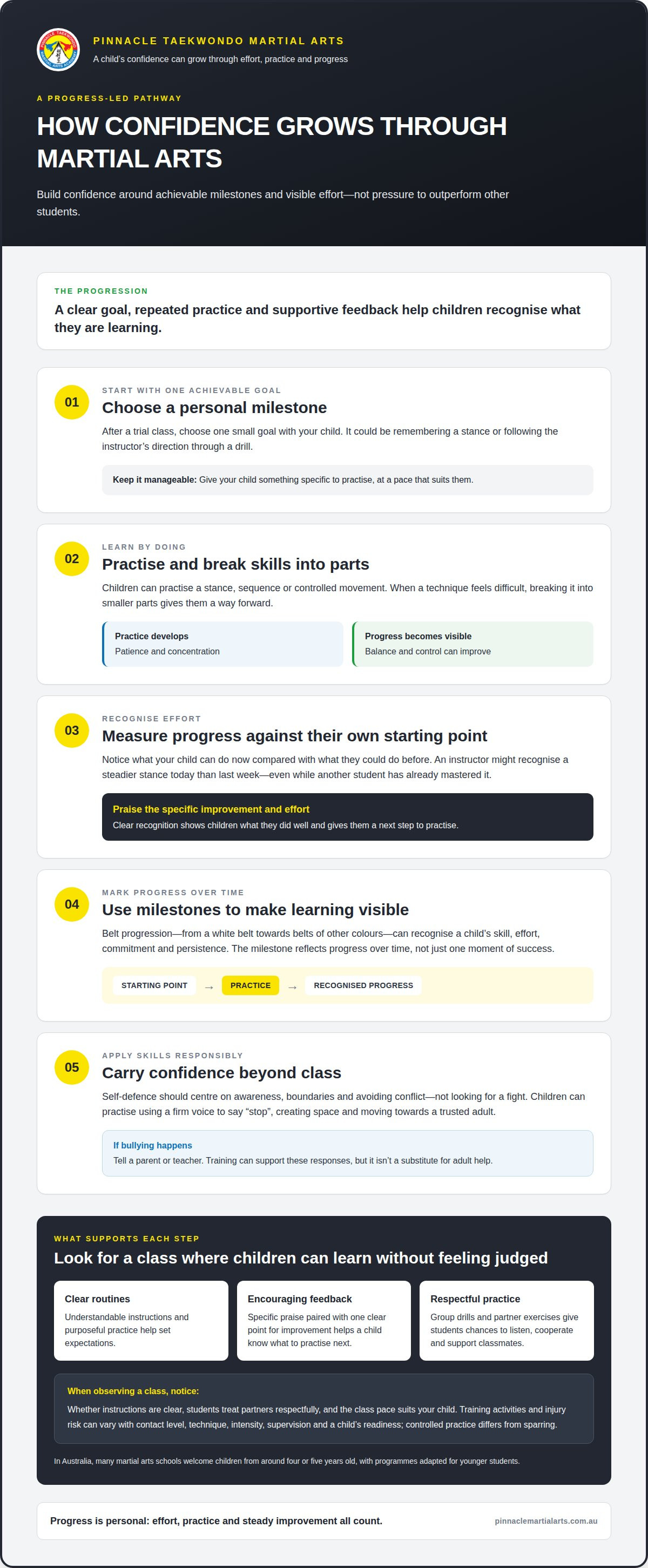
A child’s first white belt marks a starting point, not a comparison with classmates. In martial arts, confidence can grow as students recognise their effort, practise new skills and see their abilities improve over time.
Progress Without Peer Competition
Individual progress means measuring a student’s development against their own earlier ability, rather than ranking them against peers. That matters when a child is still learning a movement or needs more practice before moving forward. For example, an instructor can recognise a steadier stance today than last week, even if another student has already mastered it. This keeps the focus on effort and resilience while students train alongside a group.
Self-Esteem Through Personal Achievement
Personal achievement supports self-esteem by giving children evidence of what they can learn through practice. Belt progression offers visible milestones, from a white belt towards belts of other colours. Earning a new belt can recognise a child’s skill, effort, commitment and persistence. The milestone matters because it reflects progress over time, not just one moment of success. Each new challenge can help a child trust their ability to keep learning.
Parents can make progress feel manageable by choosing one small goal with their child after a trial class. It might be remembering a stance or following an instructor’s direction through a drill. A clear goal gives the child something specific to practise. When they reach it, recognise the improvement and effort, not just the outcome.
Martial arts and team sports can build confidence in different ways. Team sports often connect achievement with shared play and team outcomes, while martial arts can make individual skill milestones especially visible. Both can offer social connection and opportunities to learn with others. The right activity depends on whether a child is energised by team goals, personal milestones or a mix of both.
Personal progress doesn’t mean training alone. Group drills and partner exercises give students chances to listen, cooperate and support classmates learning a difficult technique. Instructors can praise a specific improvement, such as a more controlled movement or focused effort during practice. That recognition shows children what they did well and gives them a clear next step. Respect and shared effort also help create a supportive class environment.
Self-confidence through learning and mastering skills
Mastering a stance, sequence or controlled movement gives a child practical evidence of learning. Repeating a difficult technique develops patience and concentration, while better balance or sharper control makes physical improvement easier to notice. These skills build confidence through practice, not bravado.
Martial arts classes also teach discipline through clear instructions and routines. A student listens, waits for their turn and practises a movement with care. When a technique feels difficult, breaking it into smaller parts gives the child a way forward. Completing each part can make success feel earned and encourage them to keep working.
Self-defence should centre on awareness, boundaries and avoiding conflict, not looking for a fight. Children can practise using a firm voice to say “stop”, creating space and moving towards a trusted adult. If bullying happens, they should tell a parent or teacher. Training can support those responses, but it isn’t a substitute for adult help.
Emotional control matters in challenging moments. For example, a child who feels frustrated during practice can pause, listen to the instructor and try again with a calmer approach. Rehearsing that response helps them practise managing strong feelings. It also shows that confidence includes recognising limits and asking for help, not pretending to feel fearless.
Parents can reinforce responsible behaviour by talking through how a skill should be used: for learning and personal safety, never to intimidate or hurt someone. Respect for training partners makes that principle concrete. Students practise control with others, follow directions and learn that physical ability brings responsibility.
For families exploring structured training, kids’ self-defence classes can introduce practical skills alongside discipline and respectful conduct.
Supportive instruction and positive reinforcement
A structured, encouraging class helps children practise without feeling judged for mistakes. An instructor’s response to effort can shape whether a child feels ready to try again.
A Safe and Supportive Training Environment
A supportive training environment combines clear routines, respectful behaviour and activities suited to children’s ability. It matters because children learn best when expectations are understandable and practice feels purposeful. In Australia, many martial arts schools welcome children from around four or five years old, with programmes adapted for younger students. Parents can observe whether instructions are clear, students treat partners respectfully and the class pace suits their child.
Injury risk depends on factors such as contact level, technique, training intensity, supervision and a child’s readiness. Controlled practice differs from sparring, so the activity and how it is taught matter. A child’s first class may involve meeting the instructor, learning basic routines and practising simple movements. Watching how the instructor explains activities and manages partner drills can help parents understand the training environment.
Encouraging Instruction and Constructive Feedback
Supportive instruction pairs specific praise with one clear point for improvement. Children then know what they did well and what to practise next. For example, an instructor might acknowledge focused effort, then demonstrate how to adjust a stance. That feedback recognises progress without demanding perfection, helping students approach a difficult skill with patience.
The confidence benefits come through practical learning: children practise skills, receive feedback, develop control and work towards achievable goals. These experiences can support self-esteem, though martial arts training isn’t a substitute for individual support when a child needs it.
A positive school also makes support part of group training. An instructor might invite a student to ask a partner for help, then guide both through a movement. Respectful correction keeps the focus on learning rather than embarrassment. If a child repeatedly seems distressed during class, that response matters; a different group or activity may be a better fit.
Martial arts styles that may build confidence
Karate, taekwondo, Brazilian jiu-jitsu, judo and wrestling can all give children chances to practise, face challenges and develop perseverance. No single style is an automatic confidence-builder. A better fit is one where a child feels engaged, can learn steadily and receives instruction suited to their needs.
Karate and taekwondo are familiar options for families exploring martial arts. Children can work towards skills and milestones, then recognise their own improvement through continued practice. Kung fu is another option. The style name alone doesn’t tell you what a class will feel like, so consider the instructor’s approach, the activities and whether your child is keen to return.
Brazilian jiu-jitsu, judo and wrestling can also give children opportunities to build confidence. Dedicated schools such as Renzo Gracie NH illustrate how structured Brazilian jiu-jitsu training helps children practise physical skills and take on learning challenges. A child who enjoys close partner work may respond differently from one who prefers individual movements. Their interest matters because enjoyment can help sustain effort and perseverance.
For a useful comparison, look beyond the style label and consider what the child experiences in class. Do instructors explain skills clearly? Can students practise at a manageable pace? Does the training emphasise respect and controlled behaviour? Those details help parents judge whether a child can build ability and self-esteem through practice.
Some children thrive on a clear progression of skills; others need time to feel comfortable in a new group. Notice whether your child talks about learning, accepts feedback or feels proud of trying a difficult movement. Those responses can help you understand which training environment motivates them, without treating confidence as a contest between styles.
The takeaway is simple: choose for the child, not the reputation of a discipline. A suitable style gives them meaningful challenges, supportive instruction and room to develop at their own pace. Explore kids’ martial arts classes as one way to find structured training and a style that interests your child.
Pinnacle Taekwondo Martial Arts
Pinnacle Taekwondo Martial Arts offers children structured training through Kids Martial Arts, Kids Kung Fu, Kids Self Defence and Kids Taekwondo. These programmes help families explore different approaches to movement, skill practice and personal development.
If your child is ready to build skills through regular practice, or you’re looking for an activity that combines physical learning with clear structure, consider which style interests them most. Their enthusiasm can guide the next step. Confidence develops through participation, effort and progress, not a quick change or comparison with others.
To discuss children’s martial arts training and find a suitable starting point for your family, contact Pinnacle Taekwondo Martial Arts.
Make the Next Step a Small Win
Confidence can show up in quiet ways: a child volunteering to try, speaking up or staying with an unfamiliar task. Talk with your child about what feeling more confident would mean to them. Their answer can help you focus on a meaningful goal rather than choosing one based on someone else’s expectations.
After an introductory class, agree on one manageable aim together. It could be learning a new movement or feeling comfortable joining a group activity. Keep the goal flexible as your child settles into training. Notice their willingness to participate, not only whether they reach the target straight away.
Understanding how martial arts build confidence in children means seeing confidence as something they practise, not a quality they have to prove. A child’s next step can be simple: turn up, take part and learn what interests them. Let that first step belong to them.
For guidance on a suitable starting point, contact Pinnacle Taekwondo Martial Arts. Encourage your child to begin at their own pace and celebrate the effort they bring.
Frequently Asked Questions
How do martial arts build confidence in children?
Martial arts can help children build confidence by giving them chances to practise skills and see what they can do. For example, a child who feels hesitant about joining a new activity can start by following one movement, then gradually participate more fully. Recognising that effort can help them feel more capable in unfamiliar situations. Confidence grows through learning and participation, not from being fearless.
What martial arts are best for confidence in children in Australia?
Karate, taekwondo, kung fu, Brazilian jiu-jitsu, judo and wrestling can all support confidence. The best choice depends on what your child enjoys and how the class is taught. A child keen to practise kicks and hand techniques might prefer karate or taekwondo; another may be drawn to grappling styles such as judo or Brazilian jiu-jitsu. Interest can make regular participation more appealing.
How does martial arts training improve children’s self-esteem and social skills?
Martial arts training can support self-esteem as children become more comfortable trying unfamiliar activities. Classes also give them chances to practise everyday social skills in a shared setting. For instance, a child might greet a partner, take turns during a drill, listen to instructions or ask for a technique to be shown again. These small interactions help children practise communicating respectfully with peers and instructors.