 0410 686 585

You don’t need to be fit or fearless to begin. Self defence classes in Marrickville teach practical ways to respond under pressure through structured martial arts training. Classes are available for children, teens and adults, with movement and fitness built into practice.
It’s natural to wonder whether you’ll keep up, remember techniques or know what to do if you freeze. Training gives you the chance to practise step by step, become familiar with key movements and build confidence through consistent effort.
This guide explains what Marrickville self-defence training can involve, how sessions address fitness and freezing, and what to expect across different age groups. It also covers the local class-location picture, including Marrickville and Chester Hill, so you can understand where training fits into your routine.
Key Takeaways
- See how martial arts disciplines can shape practical self-defence training, from movement and balance to creating space.
- Learn why beginners can start without getting fitter first, and how steady practice can help build confidence under pressure.
- Compare what children, teens and adults can focus on in age-adapted training.
- Understand how to weigh class location and travel convenience when choosing between Marrickville and Chester Hill.
What is Martial Arts Self Defence Marrickville?
Self-defence training in Marrickville uses martial arts techniques to practise movement, awareness and responses to pressure. Reviews, instructor qualifications and safety are separate factors: compare what reviewers describe, what qualifications instructors hold and how classes are taught.
Training Across Marrickville and Chester Hill
Pinnacle Taekwondo Martial Arts offers classes across Sydney, including Marrickville, Inner West, Earlwood Canterbury area, Chester Hill Bankstown area South West & Penrith area Western Sydney. Classes blend Taekwondo, Karate, Kung Fu, Kickboxing, Boxing, Hapkido and practical self-defence. Choose an age-specific programme and location that fit your routine, then book your one free lesson now!.
Structured, Family-Friendly Training
A structured class breaks defence training into teachable steps: listen to the instructor, practise a movement, then repeat it with a partner. Age-specific programmes help children, teens and adults learn in suitable sessions. Look for clear demonstrations, respectful partner practice and time to ask questions. You don’t need to master every technique at once; steady repetition builds familiarity and control.
Close-Combat Training
Close-combat practice focuses on what to do when another person is within reach. A wrist release, for example, practises responding to a simple grab without relying on out-muscling the other person. Frame-and-turn movements use the arms to create a barrier and turn away to make space; a hip escape moves the body away from pressure. Instructors can teach these techniques through controlled partner drills.
Women’s Self-Defence Training
Women’s training can combine practical responses with movement and strength work. The University of Oregon research summary reports that self-defence training can increase women’s confidence, self-efficacy and self-esteem. In class, practise awareness, creating space and responding to a grab as distinct skills, rather than relying on strength alone. Repeated, controlled drills help make each movement more familiar and give students a clear sequence to practise.
Training concerns, including fitness and freezing
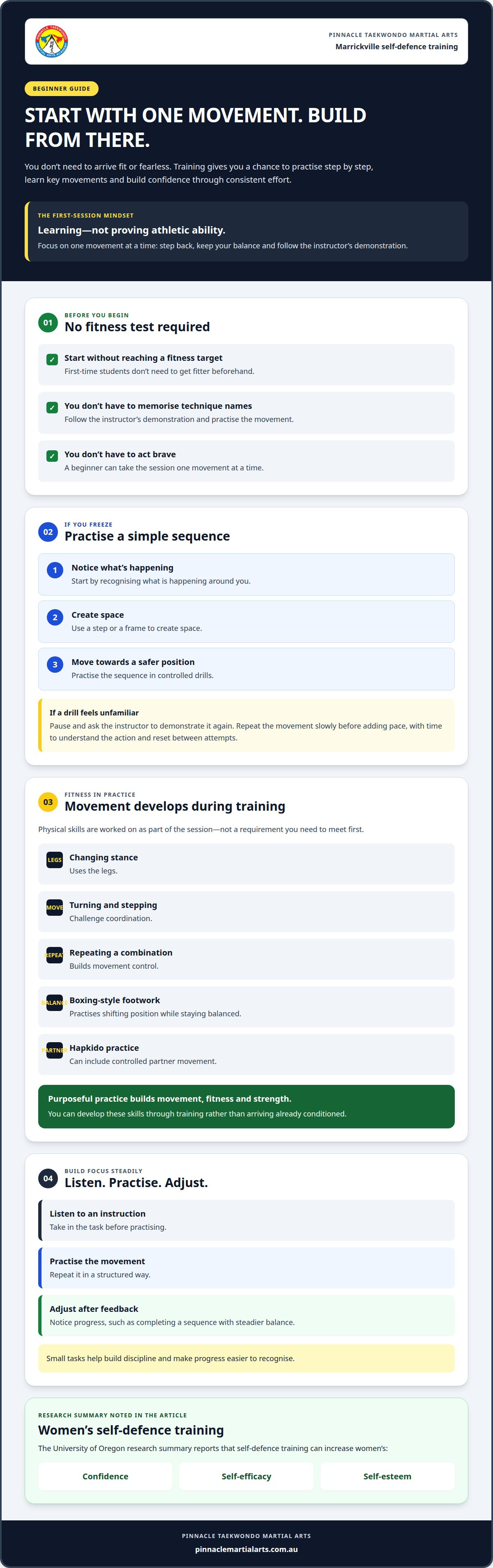
You can start martial arts training without first reaching a fitness target. First-time students don’t need to get fitter beforehand, memorise technique names or act brave. A beginner can focus on one movement at a time, such as stepping back, keeping balance and following an instructor’s demonstration. That makes the first session about learning, not proving athletic ability.
Freezing can feel like a real concern, so practise a simple sequence in controlled drills. Notice what’s happening, create space with a step or frame, then move towards a safer position. If a drill feels unfamiliar, pause and ask the instructor to demonstrate it again. Repeating a movement slowly before adding pace gives students time to understand the action and reset between attempts.
Training can also develop physical skills during the same session. A stance change uses the legs; turning and stepping challenge coordination; repeating a combination builds movement control. Boxing-style footwork, for example, asks students to shift position while staying balanced. Hapkido practice can include controlled partner movement. These activities build fitness and strength through purposeful practice, rather than requiring students to arrive already conditioned.
Focus develops through small tasks: listen to an instruction, practise the movement, then adjust after feedback. That routine builds discipline and helps students recognise progress, such as completing a sequence with steadier balance. The University of Oregon research summary reports that women’s self-defence training increases confidence, self-efficacy and self-esteem. To explore a practical starting point, take a look at martial arts training and consider which skills you want to develop first.
Adult, teen and children’s self-defence programs
Self-defence classes are available for children, teens and adults, with practice suited to each group’s learning needs. Children can start from age three. Teens and adults can work on practical responses, movement and control through martial arts training. Beginners can join without getting fitter beforehand, so current fitness doesn’t need to be a barrier to learning.
Pinnacle’s classes blend Taekwondo, Karate, Kung Fu, Hapkido, boxing, kickboxing and practical self-defence. These disciplines teach different approaches to movement and defence. Brazilian jiu-jitsu is a grappling style, while Krav Maga is a separate system; neither name describes the styles listed here. Choose based on the techniques and skills you want to practise, rather than assuming every academy teaches the same programme.
For children, a supportive school environment can make learning discipline and following instructions part of each session. Teens may value drills that build coordination, confidence and control with a partner. Adults can focus on practical skills, fitness or martial arts at a level that suits their experience. Across age groups, clear demonstrations and gradual practice help students learn movements before adding complexity.
Adults interested specifically in Brazilian jiu-jitsu should distinguish grappling practice from classes focused on Taekwondo, Karate, Kung Fu, Hapkido, boxing or kickboxing. Consider whether you want to practise standing techniques, close-range movement or ground-based grappling, then use that preference to guide your choice of style and programme.
For a first class, wear comfortable clothing that allows you to step, turn and move freely. Bring water, listen to the instructor’s directions and follow the class routine. If you’re choosing for a child, explain that they’ll practise one movement at a time and work respectfully with others. That simple preparation helps adults, teens and kids arrive ready to learn.
Class locations in Marrickville and Chester Hill
For Sydney students, Marrickville and Chester Hill are two location options for self-defence training. Choose by starting with your usual route, not just the suburb name. A nearby class can be easier to fit around work, school or family commitments. The practical takeaway: identify which location makes regular attendance more manageable.
To compare travel, enter the class address and your usual starting point into a maps app. Check the route and actual travel time, whether you’re walking, driving or using public transport, and consider the return trip too. A Marrickville student travelling from work may weigh the trip differently from a parent leaving school pick-up in Chester Hill. The address and class time shape that decision.
Location matters beyond convenience. A structured martial arts academy can give adults and young people a regular place to practise, build confidence and learn respect through training. Before settling on Marrickville or Chester Hill, consider who will travel with you, how the trip fits your week and whether the route works for every family member attending. That simple comparison helps make a class easier to sustain.
Use this quick decision process: choose the location that best matches your regular journey, map the route to the venue, then consider the return trip and family logistics. If you’re comparing locations with a child, include their school or after-school routine. If you’re an adult fitting training around work, check the journey from your usual starting point. These details help you choose a location you can keep attending.
Ready to take the next step? Explore self-defence class options and start planning which location fits your routine.
Pinnacle Taekwondo Martial Arts: Kids Martial Arts
Pinnacle Taekwondo Martial Arts offers children structured training through Kids Martial Arts, Kids Kung Fu, Kids Self-Defence and Kids Taekwondo. These programmes give families options when a child wants to build movement skills, practise self-defence or explore a martial arts style.
Choose a focus that fits your child’s interests. Kids Self-Defence centres on practical awareness and responses, while Kids Taekwondo and Kids Kung Fu introduce training through their respective disciplines. Kids Martial Arts provides a broader starting point for children beginning their martial arts journey. Each offers a way to practise focus, discipline and confidence through regular learning.
Explore Pinnacle Taekwondo Martial Arts’ age-specific programmes and book your one free lesson now!.
Choose a First Step That Fits Your Family
Turn interest into a clear starting point. For families considering self defence classes in Marrickville, think about what your child wants to practise and what kind of routine will work at home. A simple goal, such as learning to move with control or joining a structured activity, can make the first decision easier.
Pinnacle Taekwondo Martial Arts offers Kids Martial Arts, Kids Kung Fu and Kids Self-Defence. These options give families different ways to begin, whether a child is curious about a martial arts style or wants to focus on practical self-defence skills.
Before taking the next step, talk with your child about what interests them. Their input can help make training feel like a positive choice, not another task on the family calendar. Then choose the programme that best matches that interest.
Contact Pinnacle Taekwondo Martial Arts to discuss a suitable starting point. A small first step can open the door to steady learning, stronger confidence and a new sense of personal achievement.
Frequently Asked Questions
At what age can children start Martial Arts lessons?
Children can begin martial arts training from age three. A parent choosing a first class can consider whether their child is comfortable following simple instructions, taking turns and practising basic movements. Kids’ programmes include options such as Taekwondo, Kung Fu and self-defence. Starting with an age-appropriate class gives young learners a chance to become familiar with the routine and develop skills progressively.
Do I need to have prior martial arts experience?
No prior martial arts experience is needed to begin. First-time students can learn through demonstrations and practise movements at a manageable pace. You don’t need to memorise technique names or arrive feeling confident. For example, focus on listening to one instruction, trying the movement and asking for a demonstration if you’re unsure. A beginner mindset helps you concentrate on learning rather than comparing yourself with experienced students.
What are the prices?
Class pricing depends on the program and the details of the enrolment, so there isn’t one price that applies to every student. The right cost depends on the training option and participation arrangement. A quote request is the way to receive the applicable price for your circumstances. Consider which age group and style you’re interested in before requesting a quote, so the relevant program can be identified.
When and where are the classes?
Pinnacle’s classes are available across Sydney, including Marrickville, Inner West, Earlwood Canterbury area, Chester Hill Bankstown area South West & Penrith area Western Sydney. Choose the age group and training style first, then plan your visit around the class. If you’re travelling after work or school, consider the full trip, including your return journey. This helps you select a session that fits your routine.
Which Marrickville self-defence classes are suitable for beginners?
Beginners can start with structured self-defence or martial arts classes in Marrickville without previous training. Choose based on the skills you want to develop: Taekwondo, Karate, Kung Fu, Kickboxing and Hapkido offer different approaches to movement and practice. If you’re choosing for a child, select an age-specific programme. Adults can begin with basic techniques and build familiarity through regular instruction.
Where are self-defence classes held in and near Marrickville?
Pinnacle Taekwondo Martial Arts serves Sydney across Marrickville, Inner West, Earlwood Canterbury area, Chester Hill Bankstown area South West & Penrith area Western Sydney. That gives families across the Inner West and South West location options to consider. Compare a venue with your starting point and usual transport route. If travelling from further away, consider which location best fits your school, work or family commitments.